The House of Wisdom and the Translation Movement
Also called: Bayt al-Hikma, Graeco-Arabic translation movement
In Abbasid Baghdad a great movement translated Greek, Persian and Indian learning into Arabic, and scholars such as al-Khwarizmi made major advances in mathematics and astronomy.
Zereshk · Public domain · Source
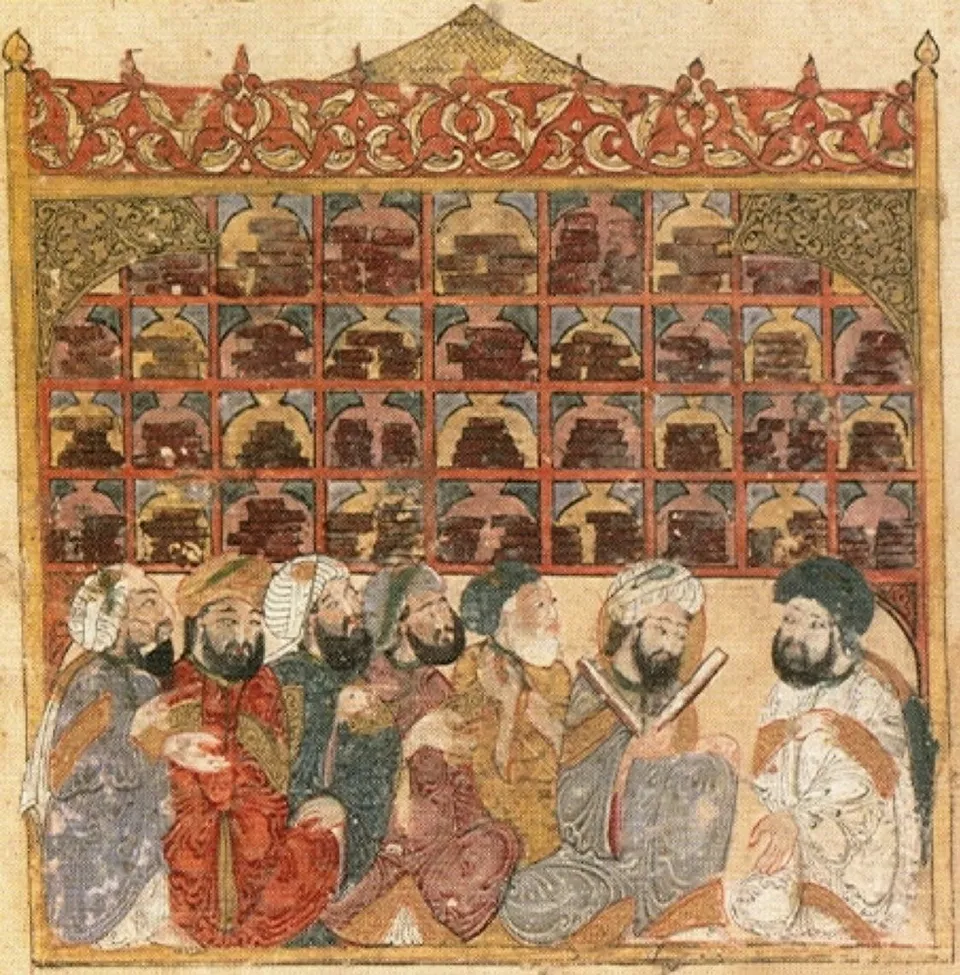
Beginning as a palace library under Harun al-Rashid, the House of Wisdom (Bayt al-Hikma) grew greatly under Caliph al-Mamun (813–833). Greek works — the philosophy of Aristotle and Plato, Euclid’s geometry, Ptolemy’s astronomy, Galen’s medicine — and Persian and Indian books were translated into Arabic, much of the work done by Christian scholars who knew Syriac and Greek, such as Hunayn ibn Ishaq. Paper, spreading after the Battle of Talas, made books cheap. Historians disagree on whether the House of Wisdom was mainly a library or a wider academy.
In his Compendious Book on Calculation by Completion and Balancing, al-Khwarizmi set out how to solve equations, laying the foundations of algebra (from al-jabr in the title), and introduced the Indian place-value numerals with zero. These numerals later reached Europe and came to be called “Arabic numerals”. Muslim scholars also advanced astronomical observation, medicine and chemistry (alchemy).
The learning preserved and developed in the Islamic world was translated into Latin in 12th-century Spain, at Toledo and elsewhere, and deeply influenced European scholasticism and the Renaissance.