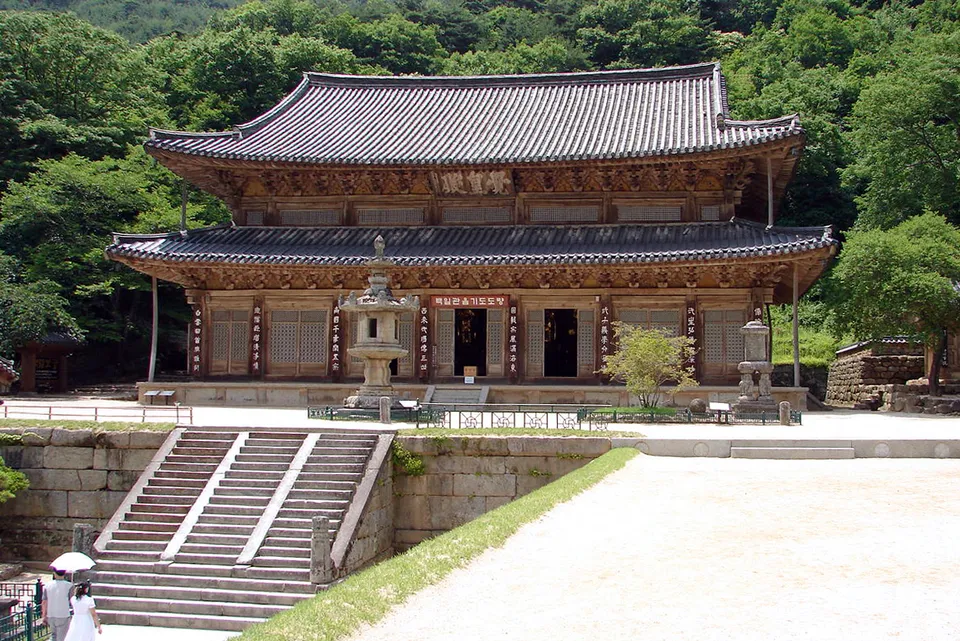
Gakhwangjeon Hall, Hwaeomsa, Gurye
A two-storey hall finished in 1702 — two storeys outside, one open space inside, in the multi-bracket style; one of the largest wooden Buddhist halls in Korea.
Steve46814 · CC BY-SA 3.0 · Source
Hwaeomsa once had Jangyukjeon, its walls lined with the Avatamsaka Sutra carved in stone, but it burned in the Imjin War. The monk Seongneung began rebuilding in 1699 and finished in 1702 (28th year of King Sukjong), and Sukjong named it "Gakhwangjeon". Two storeys outside and open inside, it is a dapo-style hall with a hipped-and-gabled roof, one of the largest wooden Buddhist halls in Korea.
It is a National Treasure, as is the Unified Silla stone lantern in front of it. Hwaeomsa also has a three-storey pagoda borne by four lions (National Treasure). With Palsangjeon at Beopjusa and Mireukjeon at Geumsansa it is grouped among the great multi-storey halls of late Joseon (around the 17th century).