Ostpolitik and the Basic Treaty
Also called: Ostpolitik, Grundlagenvertrag
As the culmination of Brandt’s Ostpolitik, the two German states signed the Basic Treaty, recognizing each other as equals and exchanging permanent missions — “change through rapprochement”.
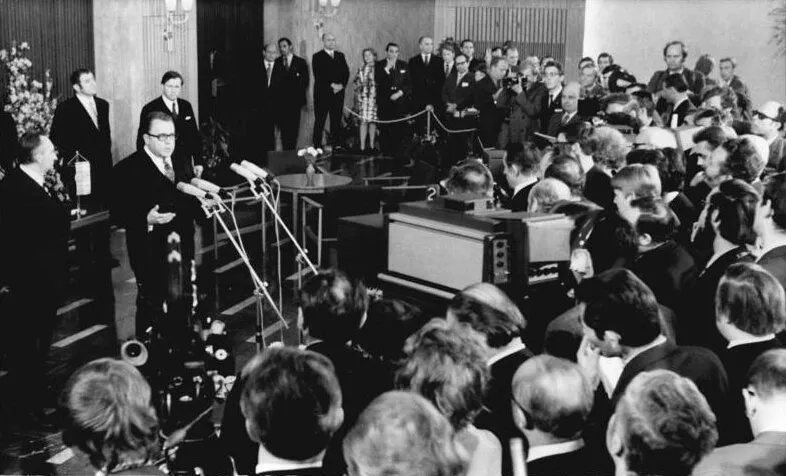
Bundesarchiv, Bild 183-L1221-0024 / Hubert Link · CC BY-SA 3.0 de · Source
Chancellor from 1969, Brandt eased relations with the East following his adviser Egon Bahr’s formula of “change through rapprochement”. In 1970 he signed the Moscow Treaty with the Soviet Union and the Treaty of Warsaw with Poland, and the two German heads of government met for the first time at Erfurt and Kassel. In 1971 the four occupying powers concluded the Berlin Agreement guaranteeing access to West Berlin.
On 21 December 1972 Bahr and East Germany’s Michael Kohl signed the Basic Treaty in East Berlin. The two states agreed to respect their border and treat each other as equals, exchanging permanent missions instead of embassies. West Germany did not regard the East as a “foreign country” and kept the goal of unity. On the Korean peninsula the same year brought the North–South Joint Statement of 4 July.