Odin’s Sacrifice, the Runes and Mímir’s Well
Also called: Hávamál, Odin’s self-sacrifice, Mímir, Mimisbrunnr, Huginn and Muninn, Runes
A legend handed down over the centuries.
A Norse myth told in the Eddic poems Hávamál (Sayings of the High One) and Völuspá and in the Prose Edda. Odin hung nine nights on a windy tree, wounded by a spear, sacrificing himself to himself to win the runes, and gave up an eye to drink from Mímir’s well of wisdom.
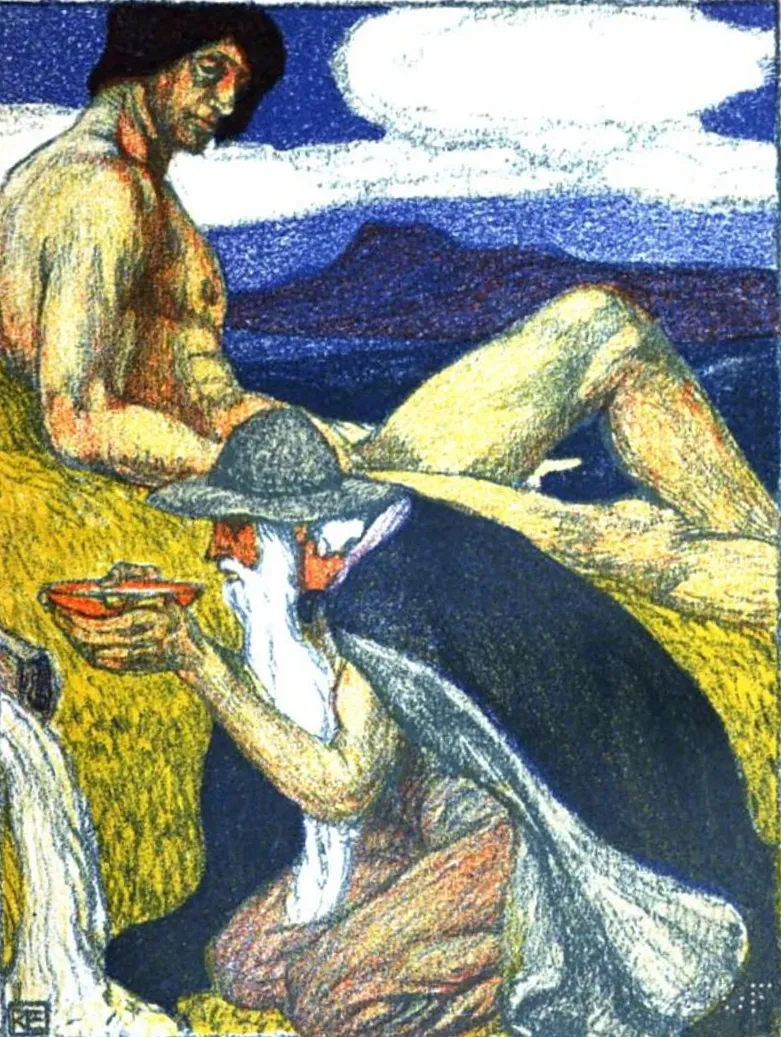
Robert Engels (1866-1920). · Public domain · Source
This Norse myth is told in stanzas 138–141 of Hávamál in the Poetic Edda. Odin says: “I hung on a windy tree nine long nights, wounded with a spear, given to Odin, myself to myself.” Without food or drink he peered downward and, crying aloud, took up the runes. The tree is usually taken to be Yggdrasil, a name often explained as “Odin’s horse”. The poem goes on to list the charms Odin knows.
Völuspá and Snorri’s Prose Edda say that Odin pledged one of his eyes to drink from Mímir’s well beneath Yggdrasil and so gained wisdom. In Snorri’s Ynglinga saga (in Heimskringla), when the Vanir gods beheaded Mímir, Odin preserved the head with herbs and consulted it for secrets. Hence Odin is pictured as one-eyed, attended by the two ravens Huginn (thought) and Muninn (memory), a god of wisdom, poetry and death.
Real runes were used by Germanic peoples from about the 2nd century AD; in the Viking Age the shortened 16-letter Younger Futhark was in use. The idea that runes came from the gods appears as early as the phrase “runes of divine origin” on the Noleby stone in Sweden (c. 6th century).