World · MythsAD 793 – 187621 events

Norse Mythology

From the world made of Ymir’s body through Odin’s runes, Thor’s adventures and the death of Baldr to Ragnarök and the rebirth of the world — Norse myth in story order, alongside the temple at Uppsala, the Oseberg ship, runestones, the Gosforth Cross, Snorri’s Edda, the Codex Regius and Wagner’s Ring
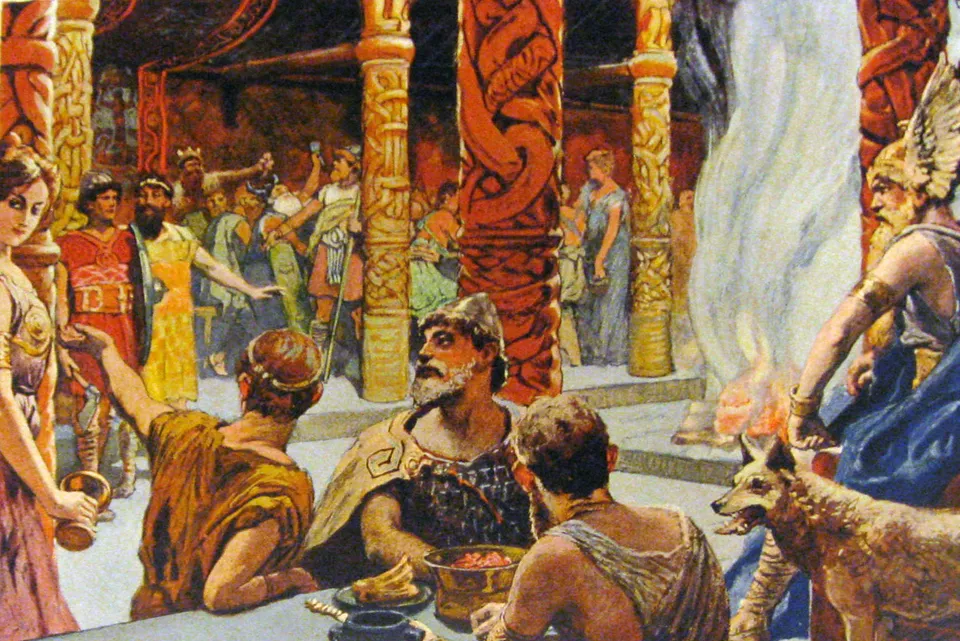
에밀 되플러, 「발할라」 — 왕좌의 오딘 앞에서 발키리가 전사들의 넋(에인헤랴르)에게 술을 따른다. 1905년 무렵 출간된 삽화

Emil Doepler · Public domain · Source

At a glance

StorySourceKind
Ginnungagap and YmirVöluspá; GylfaginningMyth
Yggdrasil and the nine worldsVöluspá; GrímnismálMyth
Odin’s sacrifice and the runesHávamál 138–141Myth
Temple at Uppsala (c. 1075)Adam of Bremen; Gamla UppsalaHistory
Nine-yearly sacrifice at UppsalaAdam of Bremen, Book 4 and scholiaLegend
Oseberg ship burial (834)Vestfold, Norway; excavated 1904History
Viking expansion (793–1066)From Lindisfarne to Normandy and RusHistory
Loki’s children and the binding of FenrirGylfaginningMyth
Thor at Útgarða-Loki’sGylfaginningMyth
Thor fishing for JörmungandrHymiskviða; GylfaginningLegend
Altuna Runestone (11th c.)Uppland, Sweden; U 1161History
Sigurd and FáfnirVölsunga saga; FáfnismálLegend
Ramsund carving (c. 1030)Södermanland, Sweden; Sö 101History
Death of BaldrGylfaginning; Baldrs draumarMyth
Punishment of LokiLokasenna; GylfaginningMyth
Gosforth Cross (c. 920–950)Cumbria, EnglandHistory
RagnarökVöluspá; GylfaginningMyth
Rebirth of the worldVöluspá; VafþrúðnismálMyth
Prose Edda (c. 1220)Snorri Sturluson, ReykholtHistory
Codex Regius (1270s)Found 1643; returned 1971History
The Ring premiere (1876)Wagner, BayreuthHistory

The theme on the map

OpenFreeMap © OpenMapTiles © OpenStreetMap contributors

21 events in this theme

  1. The Norse creation myth, told in the Völuspá (Prophecy of the Seeress) of the Poetic Edda and in Gylfaginning (The Deluding of Gylfi) of Snorri’s Prose Edda. In Ginnungagap, the empty gap between icy Niflheim and fiery Muspelheim, the giant Ymir came into being; Odin and his brothers killed him and made the world from his body.

  2. The Norse picture of the cosmos, told in Völuspá, Grímnismál and the Prose Edda. The giant ash tree Yggdrasil stands at the centre of the world, linking Asgard of the gods, Midgard of men, Jotunheim of the giants and other worlds.

  3. A Norse myth told in the Eddic poems Hávamál (Sayings of the High One) and Völuspá and in the Prose Edda. Odin hung nine nights on a windy tree, wounded by a spear, sacrificing himself to himself to win the runes, and gave up an eye to drink from Mímir’s well of wisdom.

  4. Around 1075 the German cleric Adam of Bremen wrote that there was a pagan temple adorned with gold at Uppsala in Sweden, housing statues of Thor, Odin and Freyr. It is the most famous account of Norse pagan worship, but Adam never visited Uppsala and wrote from hearsay.

  5. The sacrifice at Uppsala as told from hearsay by Adam of Bremen. Every nine years people from all over Sweden gathered at Uppsala for a nine-day feast, offering nine males of every kind of creature — humans included — and hanging their bodies in the trees of a sacred grove.

  6. In the autumn of 834 two women were buried in a Viking ship some 21.5 m long beneath a great mound at Oseberg in southern Norway. Excavated in 1904, the ship and its grave goods — a cart, sledges, textiles and more — are the richest witness to Viking Age burial and beliefs about the afterlife.

  7. From the late 8th century the Norse (Vikings) of Scandinavia sailed across Europe raiding and settling, founding the Duchy of Normandy, Kievan Rus’ and the Kingdom of Sicily, among others.

  8. A Norse myth told most fully in Gylfaginning of Snorri’s Prose Edda. The gods cast out or confined Loki’s children by a giantess — the wolf Fenrir, the serpent Jörmungandr and Hel — and bound Fenrir with the magic fetter Gleipnir, at the cost of Týr’s right hand.

  9. A Norse myth told in Gylfaginning of Snorri’s Prose Edda. Thor and Loki travel to the giants’ stronghold of Útgarðr and lose every contest — eating, running, drinking, lifting a cat and wrestling — only to learn they had been pitted against fire, thought, the sea, the Midgard Serpent and old age.

  10. A Norse myth told in the Eddic poem Hymiskviða and Snorri’s Prose Edda, and carved on stones such as the 11th-century Altuna Runestone in Sweden. Thor goes fishing with the giant Hymir and, using an ox head as bait, hauls up Jörmungandr, the Midgard Serpent — until the terrified Hymir cuts the line.

  11. In the 11th century a runestone (U 1161) was raised at Altuna in Uppland, Sweden, in memory of a father and brother. One side shows Thor in a boat fishing for Jörmungandr, the Midgard Serpent, with an ox head as bait — evidence that the myth was known in the Viking Age.

  12. A Norse heroic legend told in the 13th-century Icelandic Völsunga saga and the Eddic poems Reginsmál and Fáfnismál. Urged on by the smith Regin, the hero Sigurd kills Fáfnir, who has become a dragon; tasting the blood of its heart, he understands the speech of birds and kills the treacherous Regin.

  13. Around 1030 a runic inscription commemorating the building of a bridge was carved on a flat rock at Ramsund in Södermanland, Sweden. Around and inside the runic band are pictures of Sigurd stabbing the dragon Fáfnir and what followed — the best-known Viking Age image of the Sigurd legend.

  14. UndatedThe Death of BaldrLegend

    A Norse myth told most fully in Gylfaginning of Snorri’s Prose Edda and briefly in Völuspá and Baldrs draumar. His mother Frigg made everything in the world swear not to harm Baldr, but Loki put the unsworn mistletoe into the hands of blind Höðr, and Baldr was killed.

  15. A Norse myth told in the prose ending of the Eddic poem Lokasenna (Loki’s Flyting) and in Snorri’s Prose Edda. Loki, who caused Baldr’s death, hid as a salmon, was caught and bound to rocks with his son’s entrails, while his wife Sigyn catches in a bowl the venom dripping from a serpent above him.

  16. In the first half of the 10th century a stone cross 4.4 m tall was raised at Gosforth in Cumbria, north-west England. Alongside the Crucifixion it bears scenes read as Ragnarök — Loki bound, Víðarr tearing the wolf’s jaws, Heimdall with his horn — showing where pagan myth and Christianity met among Viking settlers.

  17. The Norse myth of the end of the world, told in Völuspá (Prophecy of the Seeress) in the Poetic Edda and in Snorri’s Prose Edda. After three winters without summer, the bound Fenrir and Loki break free; gods and giants fight their last battle, Odin, Thor and Freyr die, and Surtr’s fire engulfs the world.

  18. A Norse myth told at the end of Völuspá, in Vafþrúðnismál and in Snorri’s Prose Edda. After Ragnarök a green earth rises again from the sea, surviving gods and Baldr, returned from the dead, gather in the new world, and Líf and Lífþrasir, who hid in a wood, become ancestors of a new humankind.

  19. Around 1220 the Icelandic chieftain and poet Snorri Sturluson composed the Prose Edda at Reykholt. Written as a handbook explaining the language and metres of old poetry, its question-and-answer section on the gods, Gylfaginning, became the most important book telling Norse mythology as a continuous story.

  20. Around the 1270s a manuscript collecting old poems of gods and heroes, the Codex Regius, was written in Iceland. It is almost the only source of the Poetic Edda — Völuspá, Hávamál and the rest. Bishop Brynjólfur of Skálholt acquired it in 1643 and sent it to the Danish king; it returned to Iceland in 1971.

  21. On 13–17 August 1876 Richard Wagner’s four-part music drama The Ring of the Nibelung was first performed complete in the new Festspielhaus at Bayreuth, Germany. Weaving together Norse myth, the Völsunga saga and the German Nibelungenlied, it reshaped how modern Europe imagined Norse mythology.

Key people

  • Adam of Bremen

    11th-century scholar of Bremen Cathedral whose history of the archbishops of Hamburg-Bremen (c. 1075) describes the lands and customs of the North in its fourth book, including the temple at Uppsala

  • Snorri Sturluson1179 – 1241

    Icelandic chieftain, poet and historian, credited with the Prose Edda and Heimskringla, the history of the kings of Norway; killed at Reykholt by men acting for the Norwegian king

  • Brynjólfur Sveinsson1605 – 1675

    Lutheran bishop of Skálholt, Iceland, and scholar, who acquired the Codex Regius in 1643 and sent it to King Frederick III of Denmark in 1662

  • Richard Wagner1813 – 1883

    German composer who drew on Norse myth and Germanic legend for the four-part music drama The Ring of the Nibelung, and built the Festspielhaus at Bayreuth, where the complete cycle was first performed in 1876