Premiere of Wagner’s Ring of the Nibelung at Bayreuth
Also called: Der Ring des Nibelungen, The Ring Cycle, First Bayreuth Festival, Götterdämmerung
On 13–17 August 1876 Richard Wagner’s four-part music drama The Ring of the Nibelung was first performed complete in the new Festspielhaus at Bayreuth, Germany. Weaving together Norse myth, the Völsunga saga and the German Nibelungenlied, it reshaped how modern Europe imagined Norse mythology.
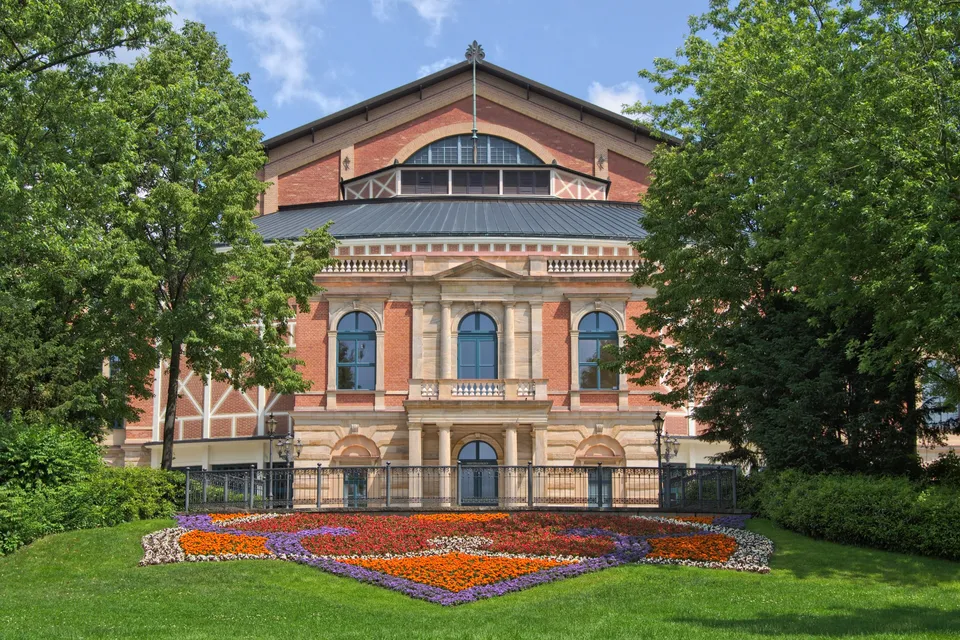
El Grafo · CC BY-SA 4.0 · Source
Over some 26 years from around 1848 Wagner composed the four parts — Das Rheingold, Die Walküre, Siegfried and Götterdämmerung. The plot draws on the Poetic Edda, the Völsunga saga, Snorri’s Prose Edda and the medieval German Nibelungenlied: Wotan (Odin), chief of the gods, a cursed ring, the hero Siegfried (Sigurd) and the Valkyrie Brünnhilde, ending in the downfall of the gods (Ragnarök). The first two parts had already been staged separately in Munich in 1869 and 1870 on the orders of King Ludwig II of Bavaria.
Wagner built a theatre for his own works alone in the small Bavarian town of Bayreuth, and from 13 to 17 August 1876, at the first Bayreuth Festival under the conductor Hans Richter, the cycle was performed complete for the first time. Emperor Wilhelm I, Ludwig II, Liszt and Tchaikovsky were among the audience. The costumes were designed by the painter Carl Emil Doepler, and the image of Vikings in horned helmets spread from around this time (there is no evidence that real Viking helmets had horns).
The first festival left large debts, and the second was not held until 1882. The title Götterdämmerung comes from rendering Ragnarök as “twilight of the gods”. The Ring went on to influence countless paintings, novels and films on Norse myth, but Wagner’s antisemitism and Nazi Germany’s promotion of his music still make it controversial.