Conflict7 July 1937 – 9 September 1945

Second Sino-Japanese War

Also called: Marco Polo Bridge Incident, War of Resistance against Japan, China Incident

A clash at the Marco Polo Bridge near Beiping on 7 July 1937 became the occasion for Japan’s full-scale invasion of China. China resisted for eight years through the United Front; from 1941 the war merged with the Pacific War, ending with Japan’s surrender in 1945.
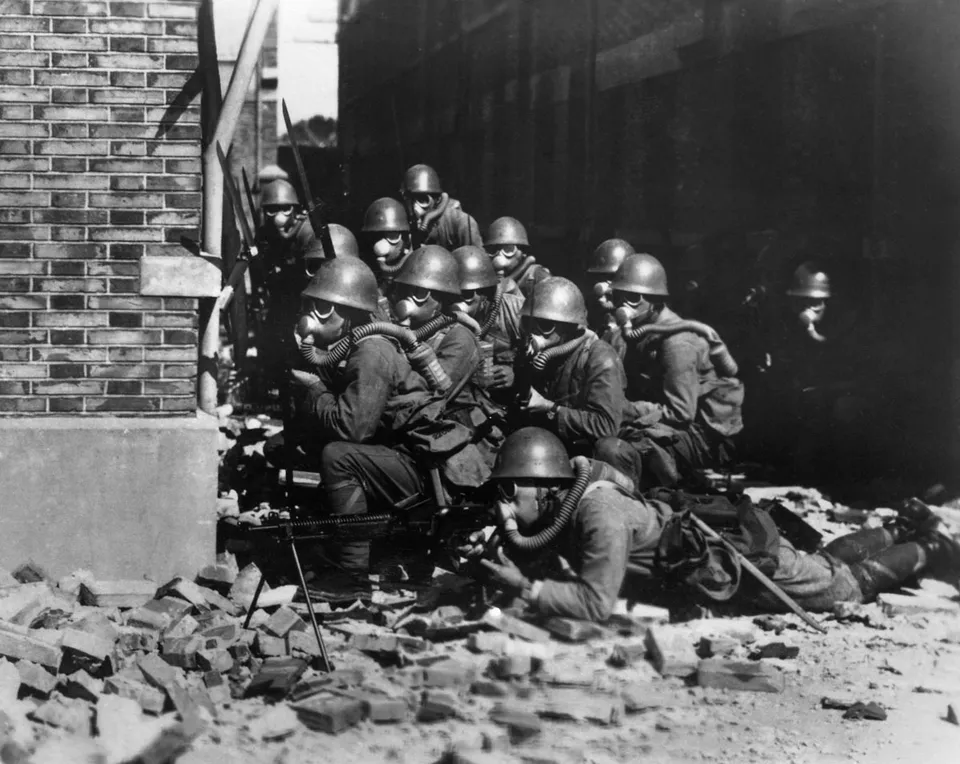
Japanese naval landing troops in gas masks preparing to advance during the Battle of Shanghai, August 1937

Unknown photographer, Ministry of the Navy · Public domain · Source

On the night of 7 July 1937 Japanese troops on night manoeuvres near the Marco Polo Bridge, citing shots and a missing soldier, clashed with Chinese troops in the walled town of Wanping (the Marco Polo Bridge Incident). The Konoe Fumimaro cabinet sent large forces; the Japanese army took Beiping and Tianjin and in August attacked Shanghai. After three months of fighting there, the capital Nanjing fell in December.

The National Government withdrew via Wuhan to Chongqing and fought a war of attrition, “trading space for time”. In 1938 Japan declared it would “no longer deal with the National Government”, proclaimed a “New Order in East Asia”, and used the National Mobilization Law to put Japan and its colonies on a war footing. The Japanese army held the main cities and railways but could not control the vast countryside, and the bombing of Chongqing and mopping-up campaigns in north China killed many civilians. In 1940 Japan set up a collaborationist government in Nanjing under Wang Jingwei.

As the war dragged on, Japan pushed into Southeast Asia in search of resources and in 1941 started the Pacific War. Many estimates put Chinese military and civilian casualties above 10 million; the Chinese government puts the figure at 35 million. Korean independence forces fought alongside China in the Korean Volunteer Corps and the Korean Liberation Army, while Korea itself was made a supply base, stripped of goods and people.

The map in 1937

OpenFreeMap © OpenMapTiles © OpenStreetMap contributors

States and rulers at the time
Japan · invader — Emperor Shōwa
Republic of China · invaded
Manchukuo
Korea under Japanese rule — Governor-General Minami Jirō
Places
Marco Polo Bridge (Lugou Bridge), Nanjing

People

  • Chiang Kai-shek1887 – 1975

    commander · Leader of the Chinese Nationalist Party who unified China through the Northern Expedition and led the Nanjing government through the war with Japan; after losing the civil war he moved to Taiwan and ruled the Republic of China there

  • Konoe Fumimaro1891 – 1945

    leader · Aristocratic prime minister (1937–1939, 1940–1941) who widened the war in China and built the wartime order — the National Mobilization Law, the “New Order in East Asia” and the Imperial Rule Assistance Association; he took his own life when named a war-crimes suspect

  • Hirohito (Emperor Shōwa)1901 – 1989

    monarch · Emperor of Japan (r. 1926–1989), sovereign during the war with China and the Pacific War, who announced the surrender by radio on 15 August 1945

  • Wang Jingwei1883 – 1944

    related figure · Veteran Nationalist leader and follower of Sun Yat-sen who collaborated with Japan during the war and set up a client regime in Nanjing in 1940

  • Mao Zedong1893 – 1976

    commander · Chairman of the Chinese Communist Party who won the civil war and founded the People’s Republic in 1949, and launched the Great Leap Forward and the Cultural Revolution

2 parts of this event

  1. 1
    1937 – 1941Second United Front

    When the war with Japan broke out, the Nationalists and Communists joined hands again in September 1937 to form an anti-Japanese national united front; the Red Army was reorganized as the Eighth Route Army and the New Fourth Army of the National Revolutionary Army.

  2. 2
    1937 – 1938Nanjing Massacre

    After capturing Nanjing, capital of the Republic of China, on 13 December 1937, the Japanese army spent several weeks massacring prisoners and civilians and committing rape, looting and arson.

Before and after

Related works

Dramatized works (films, dramas, novels) may differ from the historical record.

Themes that include this event

  • Republican China and Imperial Japan1912 – 1949

    The age when the Republic of China, born of the 1911 Revolution, passed through warlord division, the May Fourth Movement, the United Front and the Northern Expedition, fought Japan’s invasion and split in civil war — as Japan moved from Taishō democracy through the Manchurian Incident and military coups to the war in China and the Co-Prosperity Sphere, and colonized Korea resisted through the March First Movement and armed struggle