Conflict16 November 1532 – 1533

Spanish Conquest of the Inca Empire

Also called: Battle of Cajamarca

Spain’s Francisco Pizarro entered an Inca Empire divided by civil war, captured and executed the emperor Atahualpa at Cajamarca, and took the capital Cusco, bringing down the empire.
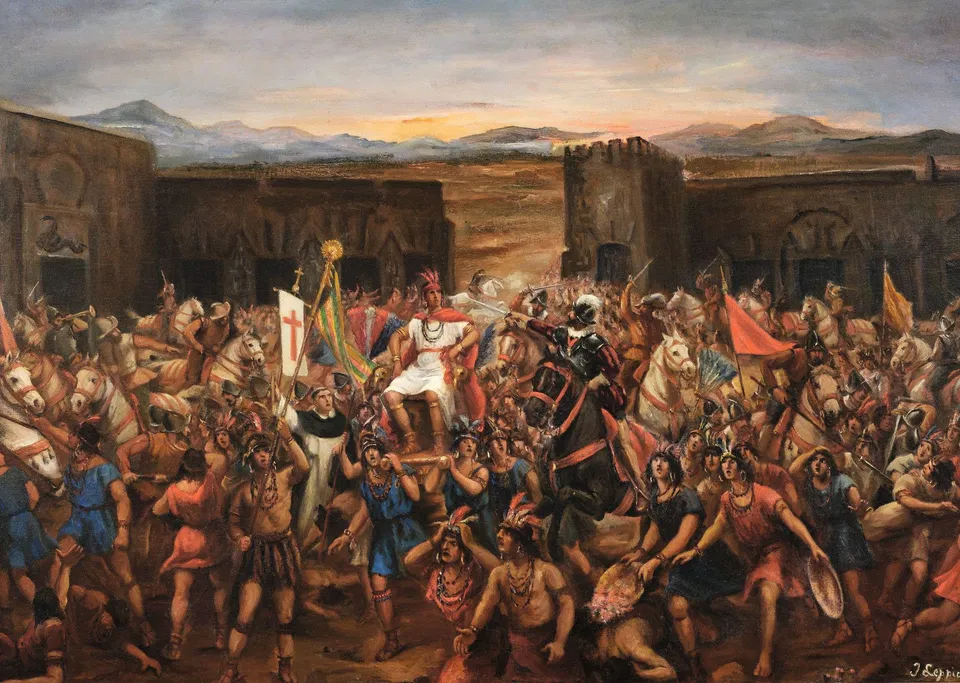
The Capture of Atahualpa — painting by Juan Lepiani, 1920s

Juan Lepiani · Public domain · Source

After the emperor Huayna Capac died of smallpox, his sons Huáscar and Atahualpa fought a civil war. On 16 November 1532 Pizarro, with some 180 men, ambushed and captured Atahualpa at Cajamarca. Atahualpa paid a ransom of a room filled with gold but was executed in July 1533. Pizarro entered Cusco that November and founded Lima on the coast in 1535. Inca resistance continued at Vilcabamba until 1572. Peru became a source of Spanish silver and wealth.

The map in 1532

OpenFreeMap © OpenMapTiles © OpenStreetMap contributors

States at the time
Spain · conqueror
Inca Empire · fell
Places
Cajamarca, Cusco

People

  • Francisco Pizarro1541

    commander · Spanish conquistador who captured the Inca emperor Atahualpa at Cajamarca in 1532, conquered the Inca Empire and founded Lima

  • Atahualpa1533

    monarch · Last Inca emperor, captured by Pizarro just after winning a civil war against his brother Huáscar, and executed in 1533

  • Charles V1500 – 1558

    related figure · King of Spain (as Charles I) and Holy Roman Emperor, who sponsored Magellan’s voyage and under whom the Aztec and Inca empires were conquered

Before and after

Related works

Themes that include this event

  • Turkic-Islamic Empires and Other Civilizations1000 – 1533

    From the Ghaznavid raids on India to the Mughal Empire and Suleiman I — five centuries in which Turkic-led Islamic empires took western Asia and India, while Africa, Southeast Asia and the Americas raised civilisations of their own

  • The Age of Discovery1415 – 1600

    From Ceuta to the Manila galleons — two centuries in which European ships crossed the oceans and bound the world together by sea