World history1415 – 160017 events
The Age of Discovery
From Ceuta to the Manila galleons — two centuries in which European ships crossed the oceans and bound the world together by sea
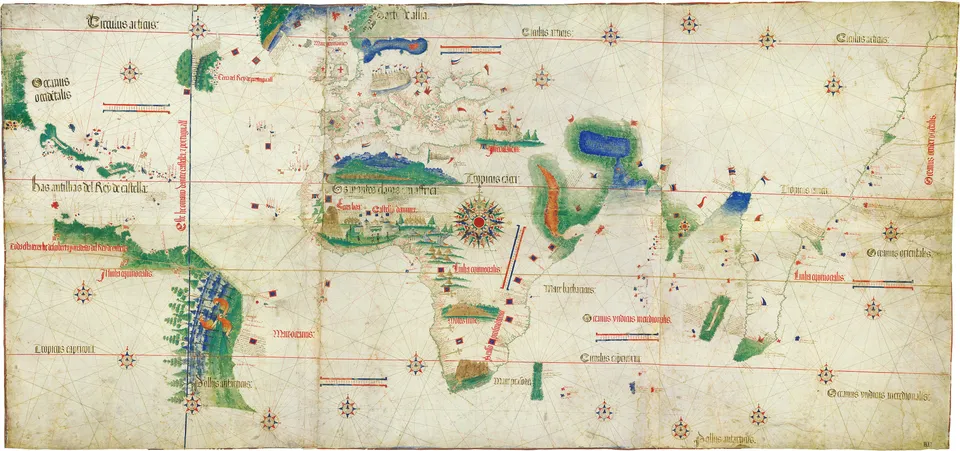
anonymous Portuguese (1502) · Public domain · Source
From Ceuta to the Manila galleons — two centuries in which European ships crossed the oceans and bound the world together by sea
anonymous Portuguese (1502) · Public domain · Source
John I of Portugal seized Ceuta, a Muslim port across the Strait of Gibraltar — often counted as the first step in Europe’s overseas expansion.
Prince Henry of Portugal sponsored voyages that settled Madeira and the Azores and pushed exploration south along the West African coast.
Portugal’s Bartolomeu Dias sailed round the southern tip of Africa into the Indian Ocean, opening the way to India around Africa.
After Columbus’s voyages, crops, livestock, people and germs crossed between the Americas and Afro-Eurasia. Potatoes, maize and chili peppers spread worldwide, while epidemics devastated Indigenous American populations.
Sponsored by Spain, Christopher Columbus crossed the Atlantic and landed in the Bahamas.
Spain and Portugal agreed to divide newly discovered lands along a meridian in the Atlantic — the west to Spain, the east to Portugal.
Portugal’s Vasco da Gama sailed round southern Africa and reached Calicut in India. A direct sea route from Europe to Asia was open, transforming world trade.
Bound for India, Cabral’s Portuguese fleet swung far west, sighted the Brazilian coast and claimed it for Portugal — the beginning of Portuguese Brazil.
Portugal’s Afonso de Albuquerque took Goa in India and Malacca, the key to Southeast Asian trade. Portugal sought to control the Indian Ocean spice trade through a network of fortified ports.
Sponsored by Spain, Magellan’s fleet crossed the Atlantic and the Pacific westward. Magellan died in the Philippines, but Elcano brought the last ship home, completing the first voyage around the world.
Spain’s Hernán Cortés, allied with Indigenous peoples hostile to the Aztecs, took the capital Tenochtitlan. The Aztec Empire fell and New Spain (Mexico) was founded.
Lapulapu, chief of Mactan in the Philippines, repelled Magellan, who had come demanding baptism and submission. Magellan was killed in the fight.
Spain’s Francisco Pizarro entered an Inca Empire divided by civil war, captured and executed the emperor Atahualpa at Cajamarca, and took the capital Cusco, bringing down the empire.
A ship carrying Portuguese reached Tanegashima in Japan, bringing the first matchlock guns. Soon mass-produced in Japan, they transformed the wars of the Sengoku period and the Imjin War.
A mountain of silver, Potosí, was found in the Andean highlands of Spanish Peru. American silver flowed into Europe and Asia, binding the world economy together.
Portuguese merchants began to reside at Macau on the Pearl River estuary with Ming permission. Macau became a hub of trade linking China, Japan and Europe and a base for Christian missions.
Spain found a return route across the Pacific from the Philippines to Mexico and founded Manila. For 250 years galleons crossed the Pacific, exchanging American silver for Chinese silk and porcelain.
King of Portugal who sent the voyages of Vasco da Gama and Cabral and built Portugal’s Asian trading empire
King of Spain (as Charles I) and Holy Roman Emperor, who sponsored Magellan’s voyage and under whom the Aztec and Inca empires were conquered
Portuguese prince, son of John I, whose sponsorship of voyages down the West African coast opened the Age of Discovery
Genoese navigator who, sponsored by Spain, crossed the Atlantic and reached the Americas in 1492
Portuguese-born navigator who, sponsored by Spain, sailed west for the Spice Islands and was killed on Mactan in the Philippines in 1521
Founder of Portugal’s House of Aviz, who led the expedition to Ceuta in 1415
Portuguese navigator who first rounded the Cape of Good Hope at the southern tip of Africa in 1488
Queen of Castile who, ruling Spain with Ferdinand II of Aragon, conquered Granada and sponsored Columbus’s voyage
Portuguese navigator who rounded Africa and reached Calicut in India in 1498, opening the sea route to India
Portuguese navigator who reached Brazil on the way to India in 1500 and claimed it for Portugal
Governor of Portuguese India who took Goa, Malacca and Hormuz, linking Portugal’s naval bases across the Indian Ocean
Basque Spanish navigator who brought the Victoria home in 1522 after Magellan’s death, completing the first circumnavigation