Opening of the Suez Canal
The Suez Canal linking the Mediterranean and the Red Sea opened, greatly shortening the sea route from Europe to Asia.
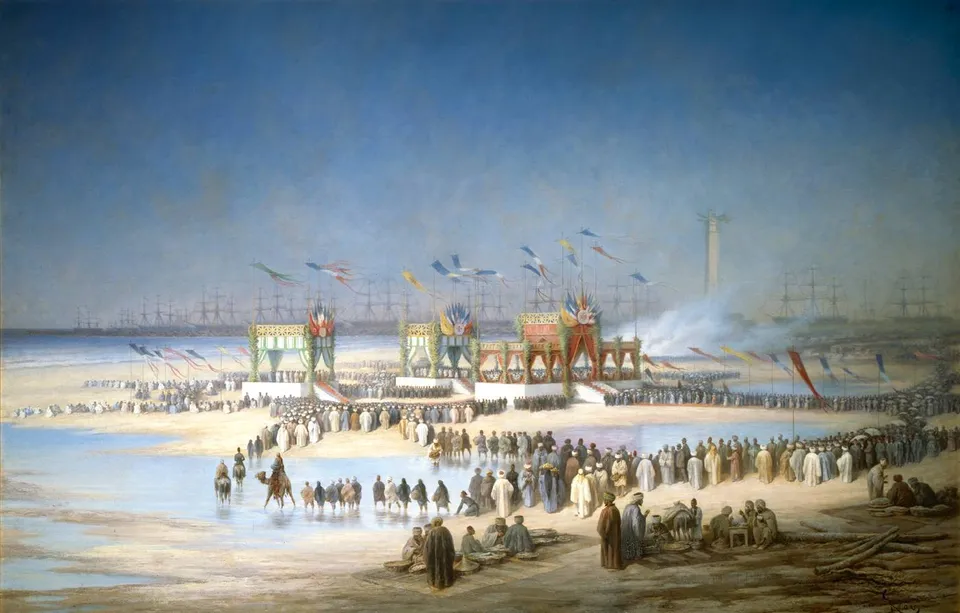
Édouard Riou · Public domain · Source
The Frenchman Ferdinand de Lesseps obtained the concession from Egypt’s Said Pasha and began work in 1859. Tens of thousands of Egyptian peasants were conscripted as forced labour, and ten years later, on 17 November 1869, the canal was opened in the presence of the French Empress Eugénie and others. The voyage from London to Bombay, once round the Cape of Good Hope, was cut sharply, making it easier for the European powers to push into Asia.
But the canal and other modernizing projects left Egypt deeply in debt. In 1875 Egypt sold its canal shares to Britain under Disraeli, and the next year Britain and France took joint control of Egyptian finances. As the "route to India" the canal became the lifeline of the British Empire, which led to the British occupation of Egypt in 1882.