Conflict1526 – 1529

Battle of Mohács and the Siege of Vienna

Also called: First Siege of Vienna, Battle of Mohács

The Ottoman sultan Suleiman I destroyed the Hungarian army at Mohács and three years later besieged Habsburg Vienna. The Ottomans had driven deep into Europe and reached the height of their power.
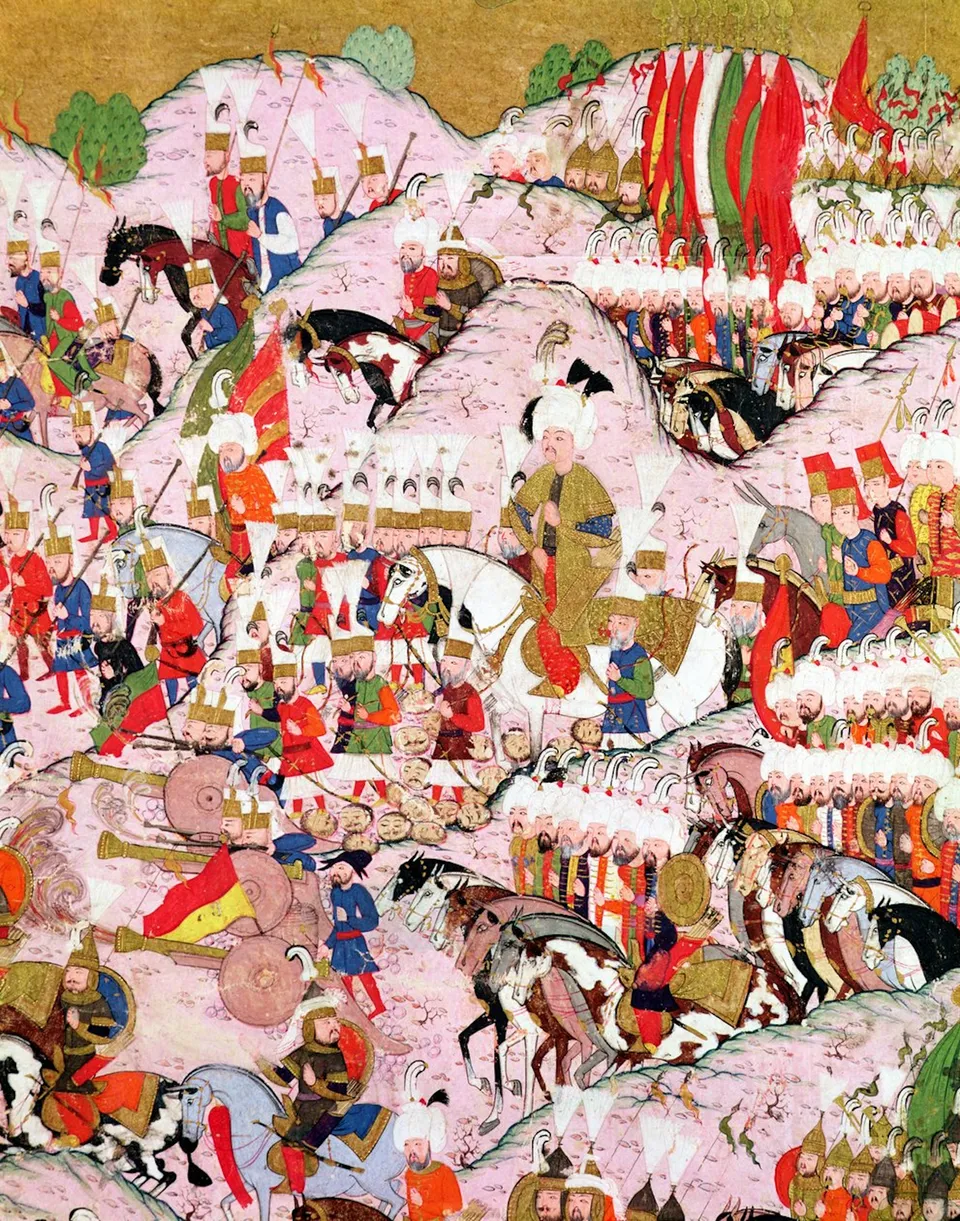
Suleiman I at the Battle of Mohács, from the Hünername of 1584 (Topkapı Palace Museum)

1584 · Public domain · Source

Suleiman I, who came to the throne in 1520, took Belgrade in 1521 and Rhodes in 1522. On 29 August 1526 at Mohács on the Danube the Ottomans crushed the Hungarian army in two hours, and King Louis II of Hungary died in flight. When a dispute over the Hungarian crown arose with the Habsburgs, Suleiman besieged Vienna in the autumn of 1529, but the late season and rain had kept him from bringing his heavy guns, and he withdrew in less than a month. Hungary was later divided in three.

Suleiman allied with France against the Habsburg Charles V, and Charles’s need to hold off the Ottomans kept him from crushing the German Lutherans — one reason the Reformation survived. Victory at Preveza in 1538 gave the Ottomans command of the Mediterranean, and Suleiman’s codification of the laws earned him the name Kanuni, “the Lawgiver”. The architect Sinan built the Süleymaniye Mosque in Istanbul.

The map in 1526

OpenFreeMap © OpenMapTiles © OpenStreetMap contributors

States at the time
Ottoman Empire · invader
Kingdom of Hungary · defeated
Habsburg Monarchy · invaded
Places
Mohács, Vienna

People

  • Suleiman I1494 – 1566

    commander · Ottoman sultan (r. 1520–1566) who crushed Hungary, besieged Vienna and dominated the Mediterranean at the height of the empire; known as “the Lawgiver”

Before and after

Themes that include this event

  • Turkic-Islamic Empires and Other Civilizations1000 – 1533

    From the Ghaznavid raids on India to the Mughal Empire and Suleiman I — five centuries in which Turkic-led Islamic empires took western Asia and India, while Africa, Southeast Asia and the Americas raised civilisations of their own

  • Islamic Empires and the Atlantic World1500 – 1800

    Three centuries in which the Ottomans of Suleiman I, the Mughals of Akbar and the Safavids of Abbas I flourished and then faltered, while across the Atlantic the slave trade and colonies transformed the Americas, leading to American independence

  • Reformation and Absolutism1517 – 1796

    From Luther’s Ninety-five Theses to Catherine the Great — the wars of religion of a divided Christendom ended at Westphalia, and absolute monarchs armed with divine right, standing armies, bureaucracies and mercantilism, followed by the enlightened despots of eastern Europe, contended for the balance of power among sovereign states