Liaoshen, Huaihai and Pingjin Campaigns
Also called: Three Great Campaigns, Liaoshen Campaign, Huaihai Campaign, Pingjin Campaign, Siege of Changchun
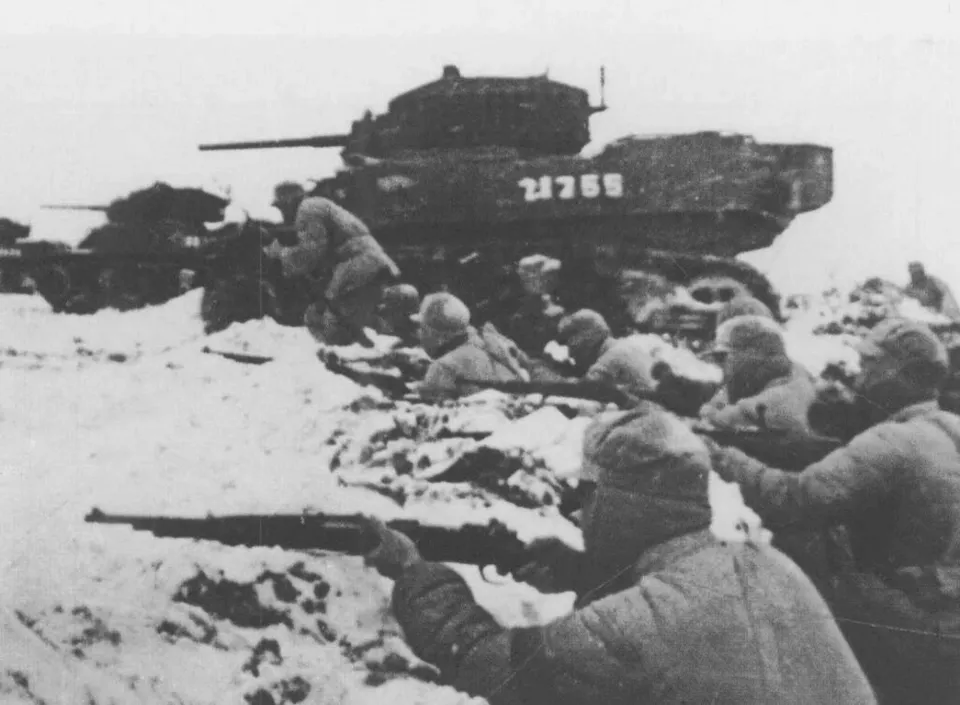
Between September 1948 and January 1949 the People’s Liberation Army won the Liaoshen campaign in the Northeast, the Huaihai campaign around Xuzhou and the Pingjin campaign around Beiping and Tianjin, destroying the Nationalist main forces. Beiping changed hands without a fight.
Unknown author · Public domain · Source
In the Liaoshen campaign (12 September – 2 November 1948) Lin Biao’s Northeast Field Army first took Jinzhou in the Liaoxi corridor (15 October), cutting off the Nationalist armies in Manchuria. Changchun surrendered in October after a siege of nearly six months during which a great many civilians inside starved to death (estimates range from around 100,000 to 300,000). Shenyang fell on 2 November, and the whole Northeast passed to the Communists.
The Huaihai campaign (6 November 1948 – 10 January 1949), centred on Xuzhou, was the largest battle of the civil war, fought by the East China and Central Plains Field Armies under a general front committee with Deng Xiaoping as secretary. The army groups of Huang Baitao, Huang Wei and Du Yuming were encircled and destroyed one after another. In the Pingjin campaign (29 November 1948 – 31 January 1949) the PLA stormed Tianjin on 15 January, and Fu Zuoyi, defending Beiping, agreed to terms; the PLA entered Beiping unopposed on 31 January.
By Chinese counts some 1.5 million Nationalist troops were killed, wounded, captured or went over in the three campaigns. Chiang Kai-shek stepped down as president on 21 January 1949, and in April the PLA crossed the Yangtze and took Nanjing.