Treaty of Brest-Litovsk
Soviet Russia made a separate peace with Germany and the other Central Powers and left the war, giving up vast lands including Poland, the Baltic region and Ukraine.
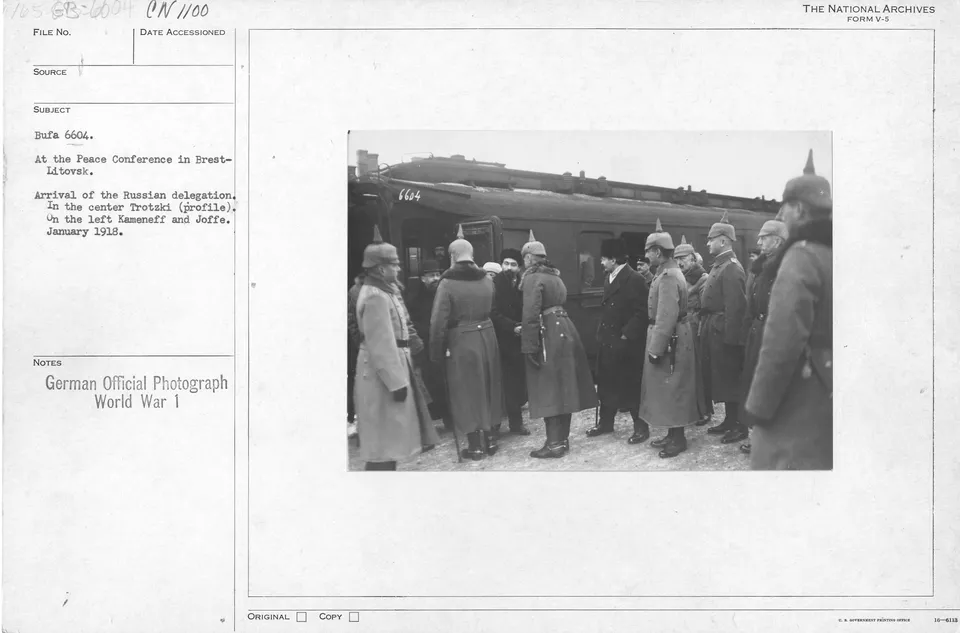
Unknown author Unknown author or not provided · Public domain · Source
After the October Revolution the Bolshevik government agreed an armistice and negotiated with the Central Powers at Brest-Litovsk. When the foreign commissar Trotsky stalled with a policy of “neither war nor peace”, the German army resumed its advance in February 1918, and Lenin overrode opposition in the party to accept still harsher terms.
Under the treaty signed on 3 March, Russia gave up Poland, Lithuania, Latvia, Estonia, Finland and Ukraine — lands holding about a third of European Russia’s population and most of its coal mines. Lenin judged that the revolution needed a breathing space to survive.
Freed from the eastern front, Germany shifted troops west for its great spring offensive of 1918, which failed. The treaty was voided when Germany signed the armistice in November, but Poland, the Baltic states and Finland, independent in the meantime, remained so.