Rise of Cabinet Government in Britain
Also called: Cabinet government, Responsible government, First prime minister
From 1721 the Whig Robert Walpole led the cabinet and came to be called the first prime minister; when he lost the support of the Commons in 1742 he resigned, beginning the practice of a cabinet responsible to Parliament.
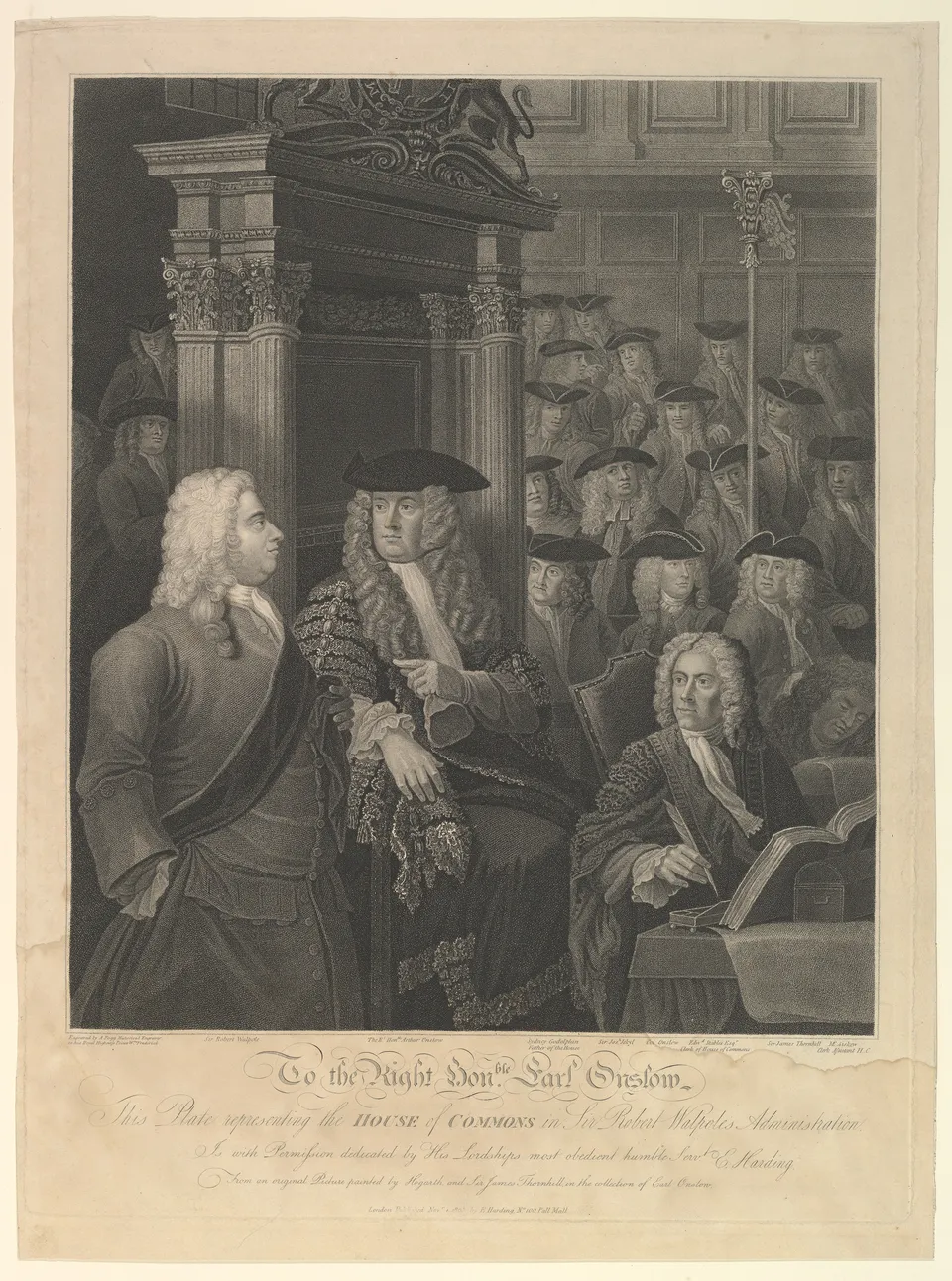
Edward Harding / James Thornhill / William Hogarth · CC0 · Source
In 1707 England and Scotland united as the Kingdom of Great Britain, and when Queen Anne died without an heir in 1714 the Elector of Hanover in Germany succeeded as George I. George, who spoke little English and took little interest in British politics, seldom attended meetings of his ministers, and in 1721 Walpole, of the Whig majority in the House of Commons, became First Lord of the Treasury and led the government.
Walpole governed for over twenty years, putting peace and sound finances first, and when he lost the support of the Commons after the 1741 election he resigned in 1742 even though he still had the king’s confidence. Thus arose the practice of cabinet (parliamentary) government, in which the majority party in the Commons forms the cabinet and the cabinet answers to Parliament rather than to the king, and the principle that “the king reigns but does not rule” took hold. At the same time in Joseon, King Yeongjo pursued his policy of impartiality (tangpyeong), erecting the Tangpyeong Stele before the Seonggyungwan in 1742.