Gilt-bronze Standing Buddha with Inscription of the 7th Year of Yeonga
Also called: Yeonga Buddha
A Goguryeo Buddha whose halo says it was made at a temple in Nangnang in the 7th Yeonga year, a gimi year. It was found at Uiryeong in former Silla territory.
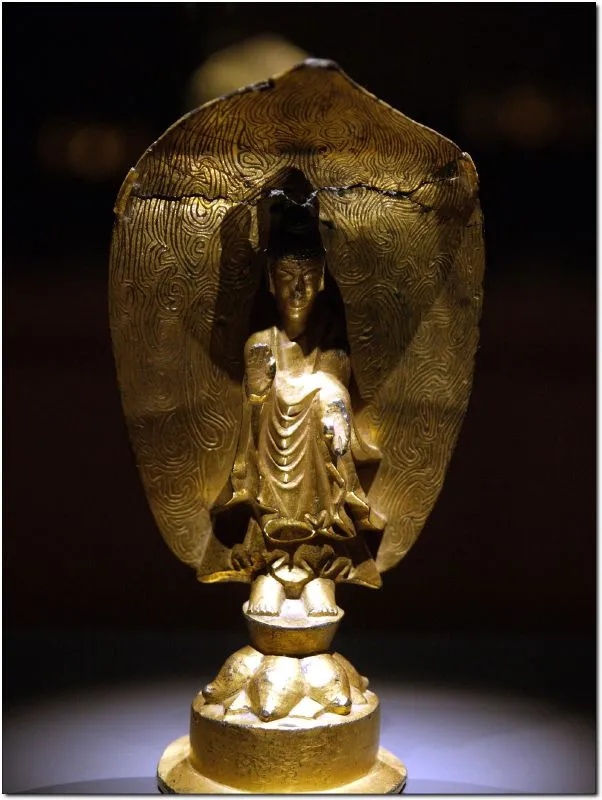
ddol-mang (a flickr user) · CC BY-SA 2.0 · Source
This small gilt-bronze figure, a little over 16 cm tall, was found at Uiryeong, South Gyeongsang Province, in 1963. The back of its halo reads that in the 7th year of Yeonga, a gimi year, monks of the Eastern Temple of Nangnang in Goryeo (Goguryeo) made a thousand Buddhas to spread the faith — proof that it was made in Goguryeo. Yeonga is taken to be a Goguryeo era name, and most scholars place the gimi year in 539.
Its long face, large halo and robe flaring out to the sides like fins show the influence of Northern Wei sculpture typical of early Three Kingdoms Buddhas. Found in Silla territory though made in Goguryeo, it shows images and the faith moving between the kingdoms. It is among the earliest datable Buddhist statues in Korea, a National Treasure, and is now in the National Museum of Korea.