Changes in Buddhist Statues
From a Goguryeo gilt-bronze Buddha in Northern Wei style and "the smile of Baekje" to the Seokguram Buddha, Balhae’s twin Buddhas, early Goryeo iron Buddhas and colossal regional stone figures
From a Goguryeo gilt-bronze Buddha in Northern Wei style and "the smile of Baekje" to the Seokguram Buddha, Balhae’s twin Buddhas, early Goryeo iron Buddhas and colossal regional stone figures

| Statue | Period · state | Material · type | Features |
|---|---|---|---|
| Yeonga 7th-year gilt-bronze Buddha | Goguryeo, c. 539 | Gilt-bronze, standing | Northern Wei style; Goguryeo inscription, found in Silla land |
| Seosan rock-carved triad | Baekje, late 6th–early 7th c. | Rock-carved | "The smile of Baekje"; on the sea route to China |
| Gilt-bronze pensive Maitreya | Three Kingdoms, late 6th–early 7th c. | Gilt-bronze, pensive pose | Maitreya faith; twin of the Kōryū-ji statue in Japan |
| Bae-ri stone Buddhas, Gyeongju | Silla, early 7th c. | Stone standing triad | Childlike faces and smiles |
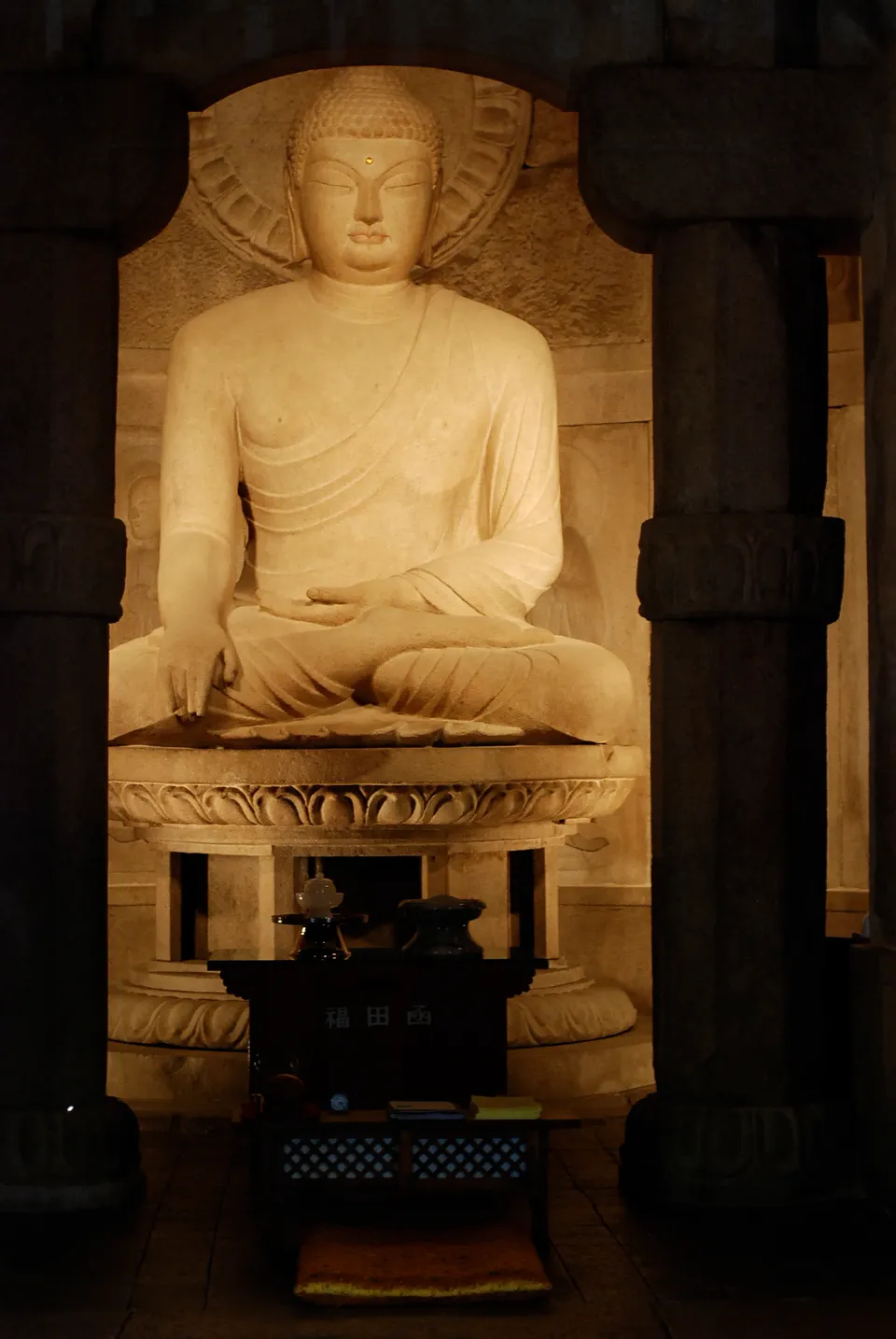
| Main Buddha of Seokguram | Unified Silla, Gyeongdeok 751 | Stone, seated (artificial grotto) | Earth-touching gesture, ideal proportions; WHS |
| Two Buddhas seated side by side | Balhae, 8th–9th c. | Paired seated Buddhas | Goguryeo style — Balhae as Goguryeo’s heir |
| Hasachang-dong iron Buddha, Hanam | Early Goryeo, 10th c. | Iron, seated | Seokguram style; iron Buddhas of late Silla–early Goryeo |
| Gwanchoksa stone Maitreya, Nonsan | Goryeo, Gwangjong 968–1006 | Colossal stone | "Eunjin Maitreya"; outsize head, regional style |
| Buseoksa clay Buddha, Yeongju | Goryeo | Clay, seated | Oldest clay Buddha; sits west, facing east, in Muryangsujeon |
| Icheon-dong rock-carved Buddha, Andong | Goryeo | Rock-carved body, separate head | "Jebiwon Buddha"; colossal, regional style |
A Goguryeo Buddha whose halo says it was made at a temple in Nangnang in the 7th Yeonga year, a gimi year. It was found at Uiryeong in former Silla territory.
Three Kingdoms gilt-bronze bodhisattvas sitting with one leg crossed over the other knee and a finger to the cheek, lost in thought. Two National Treasures are in the National Museum of Korea.
A Baekje triad carved on a rock face at Seosan. The generous, gentle smile of its central Buddha has earned it the name "the smile of Baekje".
A Silla stone triad on the western slope of Namsan, Gyeongju. Their round, childlike faces and soft smiles show the character of Three Kingdoms Silla sculpture.
Kim Dae-seong, chief minister under King Gyeongdeok, began Bulguksa and the Seokguram grotto on Mount Toham — the summit of unified Silla’s Buddhist art.
A Balhae image of two Buddhas seated side by side. Seen as continuing the Goguryeo tradition, it is cited as evidence that Balhae succeeded Goguryeo.
An early Goryeo iron Buddha some 2.8 m tall from a temple site in Hanam. It follows the style of the Seokguram Buddha and represents the iron Buddhas popular from late Silla into early Goryeo.
A colossal stone figure over 18 m tall, begun under King Gwangjong in 968 and finished in 1006. Called the "Eunjin Maitreya", it typifies the distinctive regional sculpture of early Goryeo.
A Goryeo Buddha modelled in clay, enshrined in Muryangsujeon at Buseoksa. The largest and oldest surviving clay Buddha in Korea, it carries on the Unified Silla style.
A colossal Goryeo Buddha whose body is carved on a great rock with a separately made head set on top. Called the "Jebiwon Buddha", it shows the regional character of Goryeo sculpture.
Chief minister under King Gyeongdeok who, according to the Samguk yusa, began Bulguksa and Seokguram
35th king of Silla, who sinicized official titles and place names but restored the nogeup stipend villages; Bulguksa and Seokguram were begun in his reign
Fourth king of Goryeo, who strengthened royal power with the Slave Review Act, the civil service examination and imperial titles