Yermak’s Conquest of Siberia
Also called: Russian conquest of Siberia
The Cossack leader Yermak crossed the Urals and took the capital of the Khanate of Sibir — the start of Russia’s advance across Siberia to the Pacific.
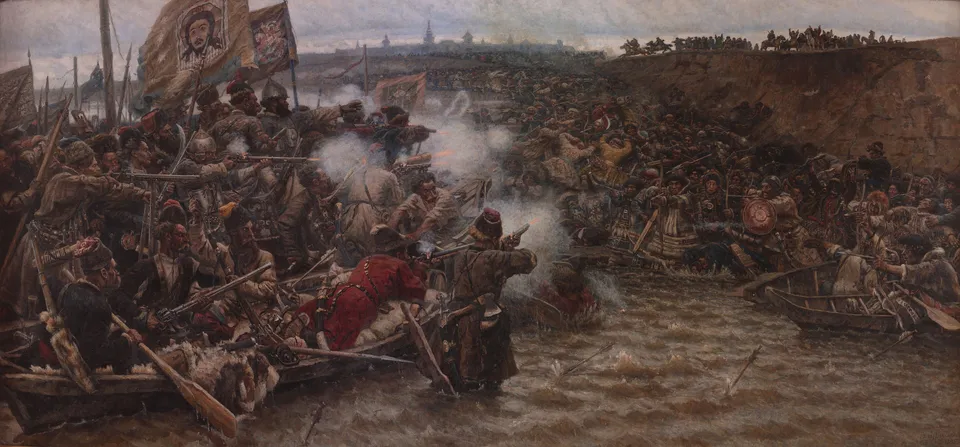
Vasily Surikov · Public domain · Source
Under Ivan IV Russia conquered the khanates of Kazan (1552) and Astrakhan (1556) and won the Volga. The Stroganovs, a merchant family grown rich on salt and furs in the Urals, hired the Cossack leader Yermak to fend off raids from the east. Around 1581 (some say 1579) Yermak led a few hundred Cossacks over the Urals, and in 1582 his muskets routed the army of Kuchum Khan and he took the capital, Qashliq (Isker). In 1585 he was ambushed on the Irtysh and drowned.
Russia then advanced along the rivers, building forts beginning with Tobolsk (1587) and taking furs from the native peoples as tribute (yasak); by the 1640s it had reached the Sea of Okhotsk. When the Russians pushed down the Amur and clashed with the Qing, Joseon sent musketeers at the Qing request to fight them (the Naseon expeditions of 1654 and 1658). The Treaty of Nerchinsk in 1689 fixed the Russian–Qing border.