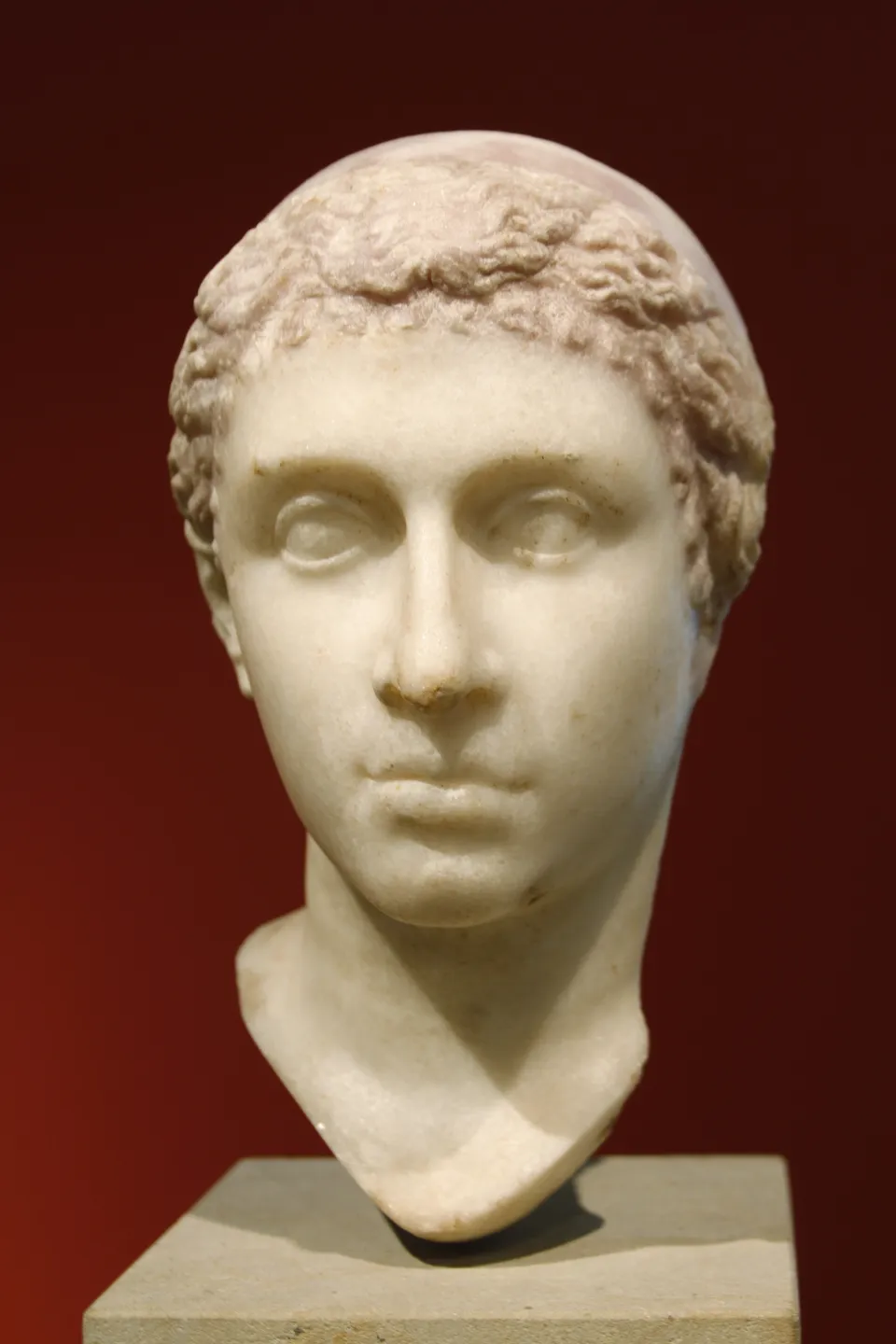
Marble head of Cleopatra VII, mid-1st century BC, Altes Museum, Berlin

José Luiz · Public domain · Source

Person69 BC – 30 BC

Cleopatra VII

Also called: Cleopatra, Cleopatra VII Philopator

Last queen of Ptolemaic Egypt (r. 51–30 BC); she sought to preserve her kingdom through alliances with Caesar and Antony, but after defeat at Actium took her own life, and Egypt became a Roman province

She was born into the Ptolemaic dynasty, the Greek line founded by one of Alexander’s generals. Plutarch says she spoke many languages and was the first of her house to learn Egyptian. She also ruled as a pharaoh in Egyptian tradition, carved on temple walls in the guise of the goddess Isis. She sought to keep Egypt from being swallowed by Rome through alliances with its strongmen, first Caesar and then Antony, but after defeat at Actium she died before Octavian could take her captive. Roman propaganda fixed her image as a seductress queen, and Pascal wrote that had Cleopatra’s nose been shorter, the whole face of the world would have changed.

Where they went

OpenFreeMap © OpenMapTiles © OpenStreetMap contributors

3 related events

  1. 1
    48 BC – 47 BCCleopatra and Caesarmonarch

    Caesar, pursuing Pompey to Alexandria, took the side of Cleopatra, who had been ousted in a struggle for the throne. After the Alexandrian War she regained the crown of Egypt.

  2. 2
    31 BCBattle of Actiummonarch

    On 2 September 31 BC, off Actium in north-western Greece, Octavian’s fleet defeated the combined fleet of Antony and Cleopatra, deciding the last civil war of the Roman Republic.

  3. 3

    When Octavian entered Alexandria in 30 BC, Antony and Cleopatra took their own lives one after the other. The Ptolemaic dynasty, nearly three centuries old, came to an end and Egypt became a Roman province.

Related works

Dramatized works (films, dramas, novels) may differ from the historical record.

People who appear alongside

  • Augustus63 BC – AD 14

    First Roman emperor (r. 27 BC – AD 14); as Octavian, Caesar’s adopted heir, he won at Actium and founded the principate

  • Mark Antony83 BC – 30 BC

    General and statesman of the late Roman Republic; Caesar’s lieutenant, he shared power with Octavian in the Second Triumvirate and ruled the East, but allied with Cleopatra and was defeated at Actium

  • Julius Caesar100 BC – 44 BC

    Statesman and general of the late Roman Republic who conquered Gaul, won the civil war and became dictator for life, and was assassinated in 44 BC

Themes this person appears in

  • Greece and Rome2000 BC – AD 476

    From the Aegean civilisation to the fall of the Western Roman Empire — the classical civilisation built by the democracy of the polis and the Roman republic and empire