The Altuna Runestone
Also called: U 1161, Altunastenen
In the 11th century a runestone (U 1161) was raised at Altuna in Uppland, Sweden, in memory of a father and brother. One side shows Thor in a boat fishing for Jörmungandr, the Midgard Serpent, with an ox head as bait — evidence that the myth was known in the Viking Age.
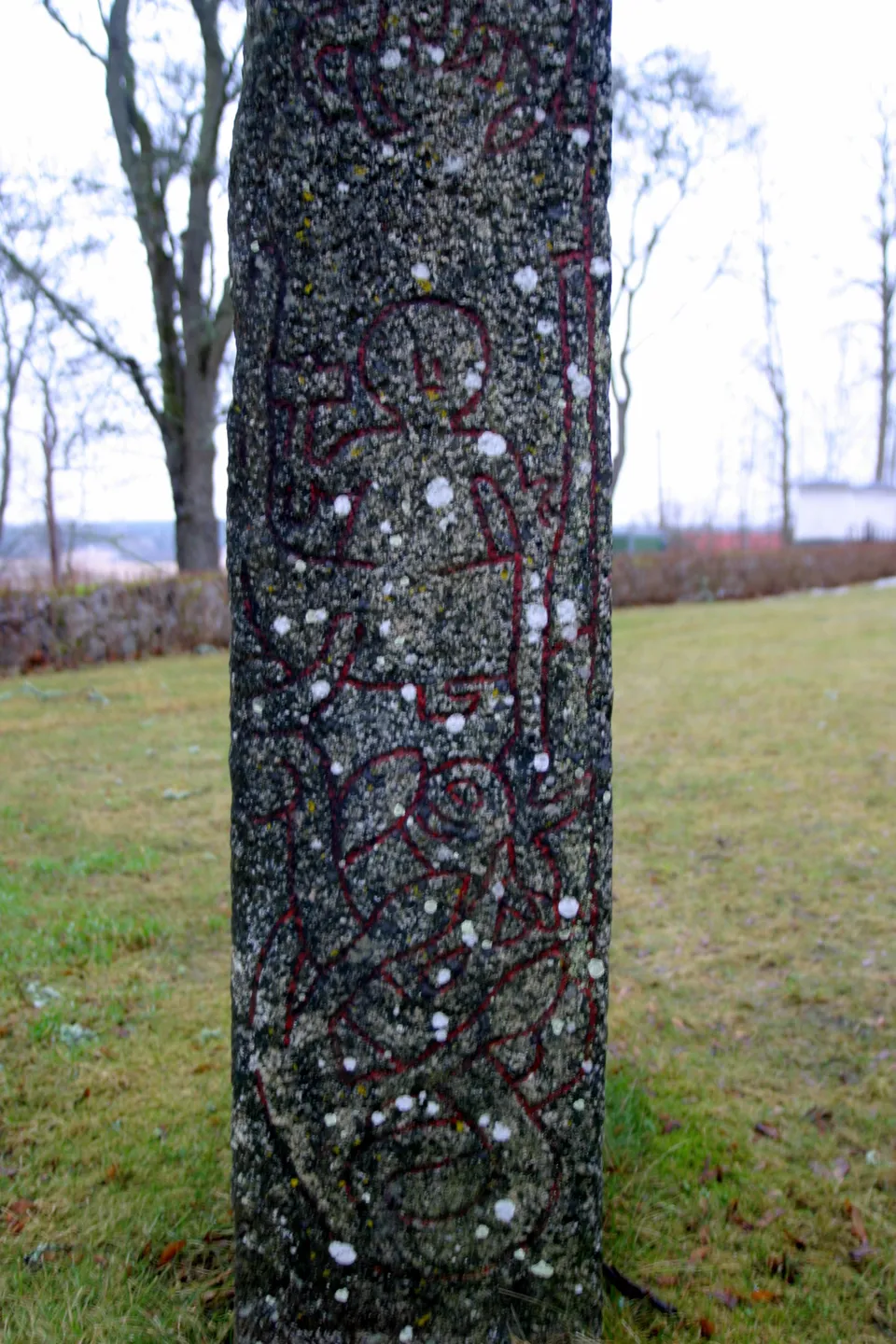
Foto Olof Ekström 2005. User OlofE on sv.wikipedia · CC BY-SA 3.0 · Source
The Altuna Runestone is a granite stone nearly 2 m tall. Its runic text says that brothers including Véfastr and Folkaðr raised it in memory of their father Holmfastr and their brother Arnfastr; a phrase saying the two were “burned” has been read as a death in a house fire. The names of the carvers, Balli and Frøystæinn, also survive. The stone was found in 1918 built into the wall of a burial chapel at Altuna church and now stands outside the church.
One face shows a man in a boat who has hooked a great serpent with an ox head on his line and, straining, has pushed one foot through the bottom of the boat. This matches Thor’s fishing trip as told in the Eddic poem Hymiskviða and in Snorri’s Prose Edda, and shows that people of the Viking Age knew the myth. The same scene appears on the Hørdum stone in Denmark and on a stone at Gosforth in England.
Whether those who raised the stone were pagans or Christians is unknown. Many 11th-century runestones in Uppland carry crosses; stones with pagan mythological scenes are rare.