The Ramsund Carving — Sigurd on the Rock
Also called: Sigurd carving, Sigurdsristningen, Sö 101
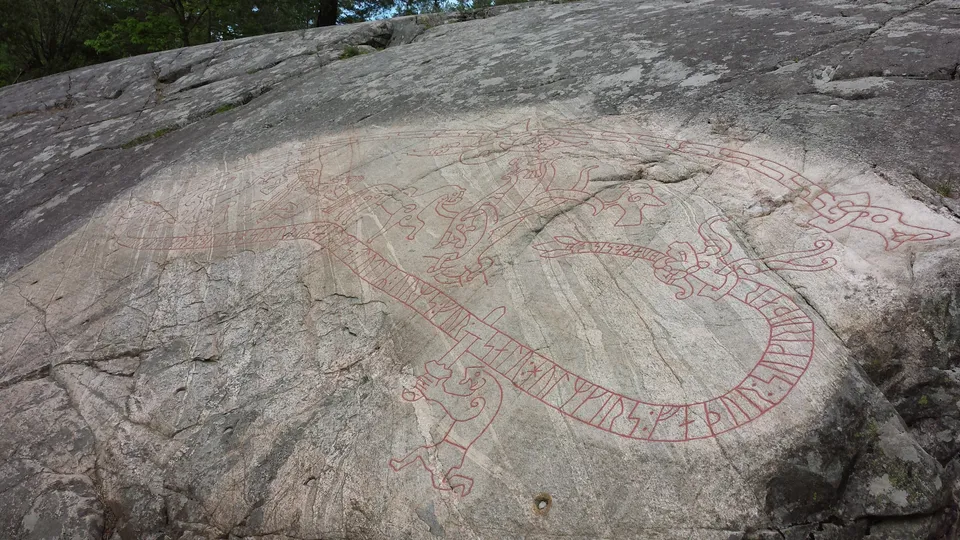
Around 1030 a runic inscription commemorating the building of a bridge was carved on a flat rock at Ramsund in Södermanland, Sweden. Around and inside the runic band are pictures of Sigurd stabbing the dragon Fáfnir and what followed — the best-known Viking Age image of the Sigurd legend.
DrRowi · CC BY-SA 3.0 · Source
The Ramsund carving (Sö 101) is cut not on a standing stone but on a flat outcrop of rock. Its runes are read as saying that Sigríðr, mother of Alríkr, made a bridge for the soul of her husband Holmgeirr (the family relationships are interpreted differently). Building bridges was counted in Christianity as a good work for the soul.
The band carrying the runes is the dragon’s body, and beneath it Sigurd thrusts his sword upward. Around it Sigurd roasts the dragon’s heart and puts his burned finger in his mouth, birds chatter in a tree, the smith Regin lies beheaded beside his tools, the horse Grani carries the treasure, and Regin’s brother Ótr appears as an otter. It shows that the story recorded in 13th-century Iceland in the Völsunga saga and the Poetic Edda was known in Sweden more than two centuries earlier.
The same scenes appear on the Gök stone (Sö 327) and others in Södermanland, and the story of Sigurd is carved on the wooden portal of Hylestad church in Norway (c. 12th century).