Conflict30 April – 6 May 1863

Battle of Chancellorsville

Lee defeated Hooker’s Union army, more than twice his size, with a daring division of his forces; but Stonewall Jackson was shot by his own men and died.
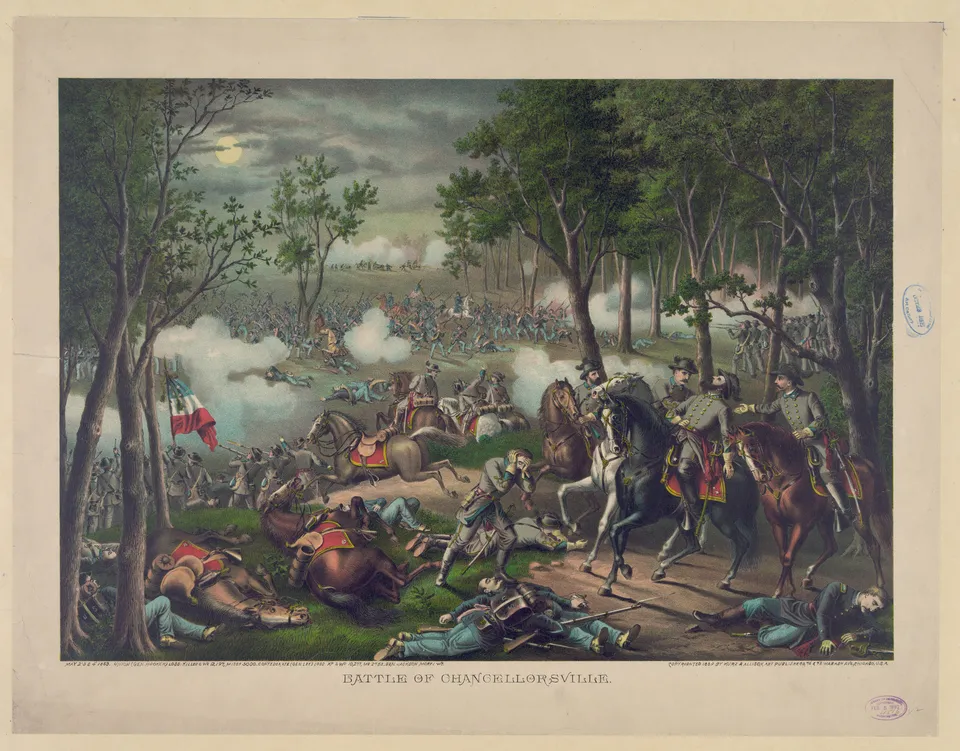
Battle of Chancellorsville — Kurz & Allison chromolithograph, 1889, Library of Congress

Kurz & Allison. · Public domain · Source

At the end of April 1863 Joseph Hooker crossed the Rappahannock with about 130,000 men to trap Lee’s 60,000. Lee split his army and on 2 May sent Jackson’s corps through the woods to strike the exposed Union right flank, routing an entire corps. Hooker withdrew across the river on 6 May.

It is reckoned Lee’s greatest victory, but the Confederates lost some 13,000 men. Returning from a reconnaissance on the night of 2 May, Jackson was hit by fire from his own troops; his left arm was amputated, and he died of pneumonia on 10 May. Emboldened, Lee invaded the North again, heading toward Gettysburg.

The map in 1863

OpenFreeMap © OpenMapTiles © OpenStreetMap contributors

States and rulers at the time
United States · defeated — President Abraham Lincoln
Places
Chancellorsville

People

  • Robert E. Lee1807 – 1870

    commander · Confederate general who led the Army of Northern Virginia to many victories, lost at Gettysburg and surrendered at Appomattox in 1865

  • Stonewall Jackson1824 – 1863

    commander · Confederate general who earned the name “Stonewall” at First Bull Run and was mortally wounded by his own men at Chancellorsville

Before and after

Themes that include this event

  • The American Civil War1850 – 1865

    From the Compromise of 1850 to Lincoln’s assassination — a nation divided over slavery fought four years of civil war, preserving the Union and ending slavery