Battle of the Yalu River
Also called: Battle of the Yellow Sea
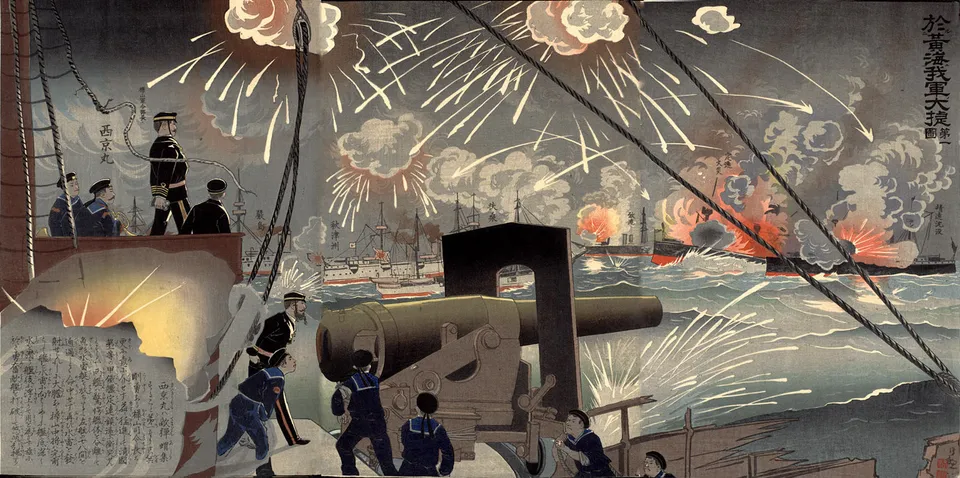
On 17 September 1894, off the mouth of the Yalu, the Japanese Combined Fleet fought the Beiyang Fleet and sank five of its ships. Japan lost none and won command of the Yellow Sea.
Public domain · Source
On 17 September 1894, the day after the Qing army collapsed at Pyongyang, Ding Ruchang’s Beiyang Fleet, returning from landing troops at the mouth of the Yalu, met Itō Sukeyuki’s Japanese Combined Fleet.
The Beiyang Fleet had big, heavily armoured ironclads, but the Japanese, with faster ships and quick-firing guns, circled it and poured in shells. After nearly five hours five Chinese ships had gone down, among them the Zhiyuan, whose captain Deng Shichang tried to ram an enemy cruiser and went down with his ship. Dingyuan and Zhenyuan survived hundreds of hits, but Japan lost not a single ship.
The surviving fleet withdrew via Lüshun to Weihaiwei and never sailed out to fight again, leaving Japan free to use the sea lanes of the Yellow Sea.