Naturec. 180 – 34 million years ago

Gondwana breaks apart

The southern continent of Gondwana split up: the South Atlantic opened between South America and Africa, India headed north, and Antarctica and Australia drifted apart.
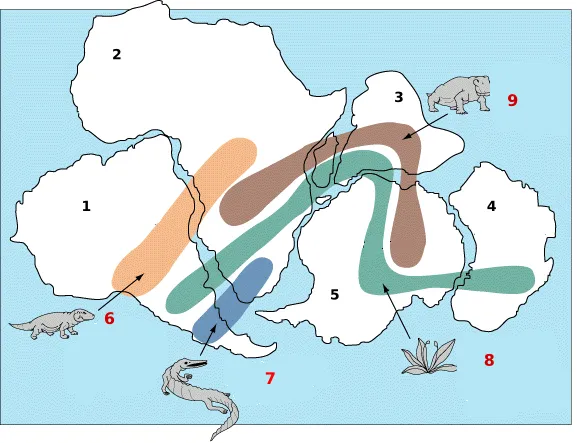
The same fossils across the split continents of Gondwana (US Geological Survey) — 1 South America, 2 Africa, 3 India, 4 Australia, 5 Antarctica; 6 Cynognathus, 7 Mesosaurus, 8 Glossopteris, 9 Lystrosaurus

USGS · Public domain · Source

From about 180 million years ago the eastern half of Gondwana (Antarctica, India, Australia) began to separate from the western half (South America, Africa). About 130 million years ago South America and Africa pulled apart and the South Atlantic opened — which is why their coastlines fit like pieces of a puzzle.

India broke away from Madagascar and raced north toward Asia at around 15 cm a year. Australia parted from Antarctica about 45 million years ago, and Antarctica, left alone and ringed by a cold circumpolar current, began to be buried in ice about 34 million years ago.

The map in c. 180 million years ago

OpenFreeMap © OpenMapTiles © OpenStreetMap contributors

Before and after

Earlier
c. 201 million years ago The breakup of Pangaea — the Atlantic opens
Later
c. 300,000 years ago Emergence of Homo sapiens

Themes that include this event

  • Drifting Continentsc. 335 million years ago – 1912

    From the single landmass of Pangaea to the opening of the Atlantic and India’s collision with Asia that raised the Himalaya — with the great extinctions and the dinosaurs along the way, and Wegener, who first said the continents move