World · Historyc. 335 million years ago – 19128 events

Drifting Continents

From the single landmass of Pangaea to the opening of the Atlantic and India’s collision with Asia that raised the Himalaya — with the great extinctions and the dinosaurs along the way, and Wegener, who first said the continents move
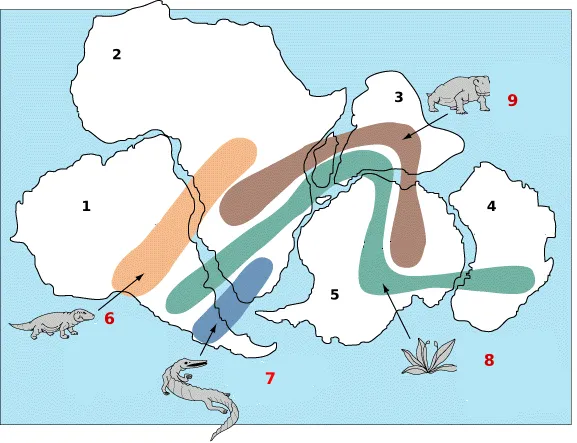
대륙이 한때 하나였다는 근거 — 갈라진 곤드와나의 대륙들에 이어지는 같은 화석 (미국 지질조사국) — 1 남아메리카, 2 아프리카, 3 인도, 4 오스트레일리아, 5 남극. 6 키노그나투스, 7 메소사우루스, 8 글로소프테리스, 9 리스트로사우루스

USGS · Public domain · Source

The theme on the map

OpenFreeMap © OpenMapTiles © OpenStreetMap contributors

8 events in this theme

  1. c. 335 million years ago – c. 175 million years agoThe supercontinent Pangaea

    The supercontinent formed when Gondwana and Laurasia collided, gathering almost all the Earth’s land into one. Ringed by the great ocean Panthalassa, it began to break apart about 200 million years ago.

  2. c. 251.9 million years agoEnd-Permian mass extinction

    About 252 million years ago immense volcanic eruptions in Siberia wiped out more than 80–90% of marine species and many land vertebrates — the largest mass extinction in Earth’s history.

  3. c. 231 million years agoThe first dinosaurs

    The earliest dinosaurs appeared in the Late Triassic, about 230 million years ago — Eoraptor and Herrerasaurus from Ischigualasto, Argentina, are the best known.

  4. c. 201 million years ago – c. 175 million years agoThe breakup of Pangaea — the Atlantic opens

    About 200 million years ago North America and Africa began to pull apart, opening the Atlantic; Pangaea split into Laurasia in the north and Gondwana in the south.

  5. c. 180 million years ago – c. 34 million years agoGondwana breaks apart

    The southern continent of Gondwana split up: the South Atlantic opened between South America and Africa, India headed north, and Antarctica and Australia drifted apart.

  6. Sixty-six million years ago an asteroid about 10 km across struck what is now the Yucatán Peninsula, Mexico. Dust and soot darkened the sky, and the non-bird dinosaurs and about three-quarters of all species vanished.

  7. Racing north, India began to collide with Asia about 50 million years ago, raising the Himalaya and the Tibetan Plateau. India is still pushing north today.

  8. The German meteorologist Alfred Wegener first presented his theory that the continents were once joined and have since drifted apart; half a century later it was accepted as plate tectonics.

Key people

  • Alfred Wegener1880 – 1930

    German meteorologist and polar explorer who proposed continental drift in 1912; never accepted in his lifetime, he died on an expedition across the Greenland ice sheet