Politics8 – 15 March 1917 (23 February – 2 March, Old Style)

February Revolution

Also called: March Revolution

Exhausted by war and hunger, the workers and soldiers of Petrograd rose up; Nicholas II abdicated and the Romanov dynasty came to an end. Power was split between the Provisional Government and the Soviet.
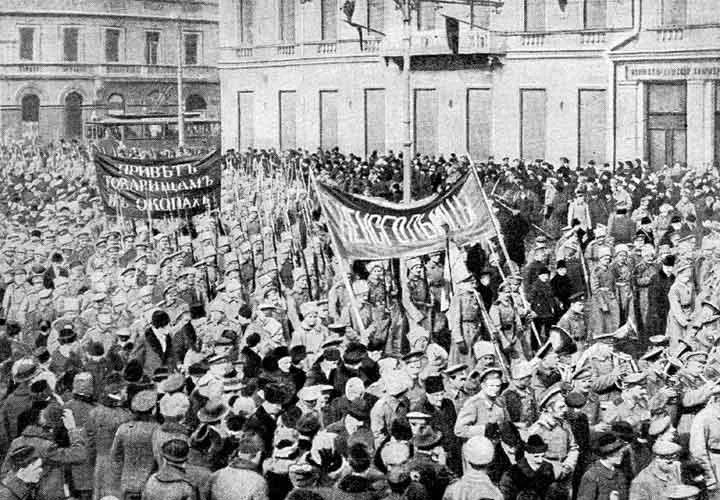
Soldiers demonstrating on the side of the revolution, Petrograd, February 1917 (Old Style)

Unknown author · Public domain · Source

On 8 March 1917 (23 February in the Russian calendar) a protest by women workers demanding bread in Petrograd grew into a general strike. When the soldiers of the capital, ordered to suppress it, went over to the crowds, the government was powerless. Delegates of workers and soldiers formed the Petrograd Soviet, and members of the Duma set up a Provisional Government.

On 15 March (2 March) Nicholas II abdicated, ending the Romanov dynasty after more than three hundred years. A Provisional Government led by liberals and a Soviet led by socialists now shared authority — the so-called “dual power”.

The Provisional Government granted freedom of speech and assembly, but kept its promises to the Allies and went on fighting, and it put off land reform until a Constituent Assembly. Returning from exile in April, Lenin called for “All power to the Soviets” in his April Theses. When an offensive launched by Kerensky, prime minister from July, also failed, support for the Bolsheviks grew rapidly.

The map in 1917

OpenFreeMap © OpenMapTiles © OpenStreetMap contributors

States at the time
Russia
Places
Saint Petersburg

People

  • Nicholas II1868 – 1918

    monarch · Last emperor of Russia (1894–1917), who abdicated in the February Revolution of 1917 and was executed with his family by the Bolsheviks the next year

  • Alexander Kerensky1881 – 1970

    participant · Minister of justice and war and then prime minister (1917) of the Provisional Government after the February Revolution; he kept Russia in the war and was overthrown in October

  • Vladimir Lenin1870 – 1924

    related figure · Leader of the Bolsheviks who set up the Soviet government in the October Revolution of 1917, chaired it, and founded the USSR in 1922

Before and after

Themes that include this event

  • World War I and the Russian Revolution1908 – 1923

    From the Balkan crises to a war of trenches and total mobilization that toppled four empires; the Russian Revolution it unleashed, which created the first socialist state; and the Versailles settlement of national self-determination and the League of Nations