Jeong Seon’s Complete View of the Diamond Mountains
Also called: Geumgang jeondo
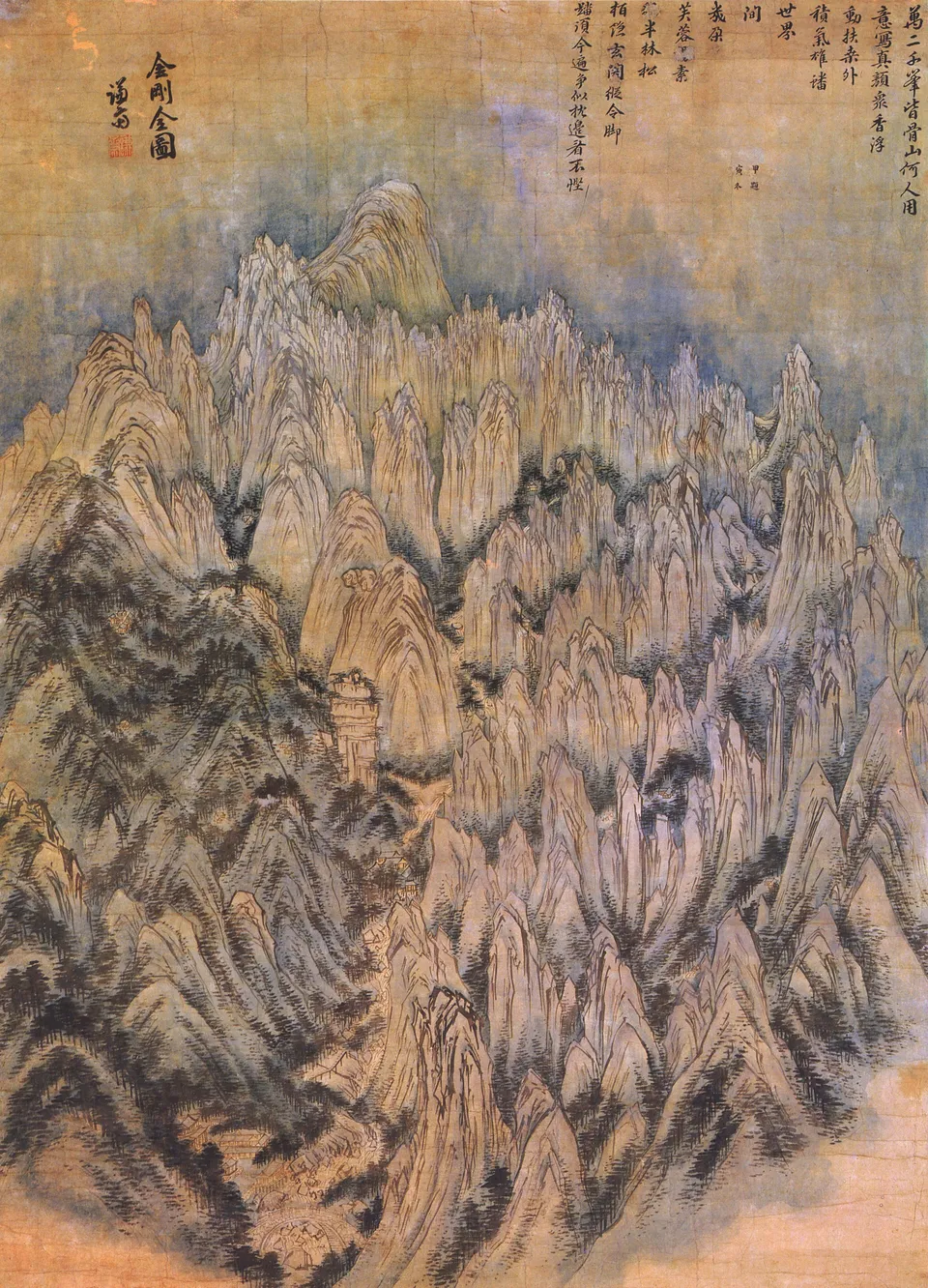
Jeong Seon gathered the peaks of the Inner Diamond Mountains into one circular composition — a true-view landscape with sharp lines for rock and soft ink dots for earthen hills.
Jeong Seon · Public domain · Source
Jeong Seon painted it in 1734, aged fifty-nine. The “twelve thousand peaks” of the Inner Diamond Mountains are gathered in a circle as if seen from the sky. Jagged rock peaks on the right are drawn in sharp vertical strokes, while the wooded earthen hills on the left are built of soft ink dots. It is a National Treasure in the Leeum Museum of Art.
Jeong Seon left behind imaginary landscapes copied from Chinese models and founded true-view landscape painting, depicting Korea’s own scenery as he saw it. With Inwang jesaekdo (1751) it is his masterpiece, linked to late Joseon’s growing pride in its own culture.