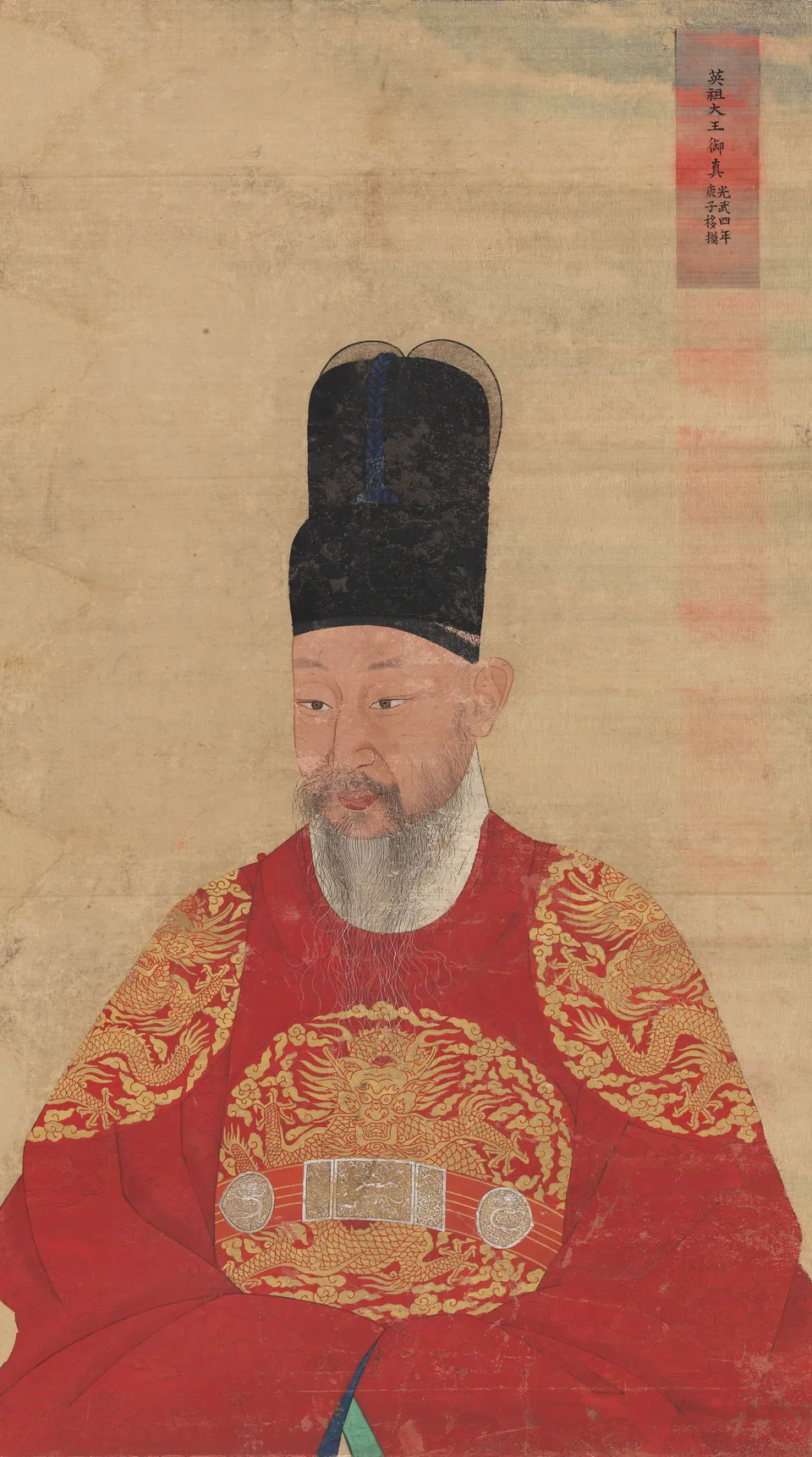
Royal portrait of King Yeongjo — 1900 copy by Chae Yong-sin and Jo Seok-jin, National Palace Museum

Chae Yong-sin / Jo Seokjin · Public domain · Source

Person1694 – 1776

Yeongjo

Twenty-first king of Joseon, known for his impartiality policy and tax reform, and for the death of his son

After Yi In-jwa's Rebellion he pursued the policy of impartiality (tangpyeong) to uproot factionalism, setting up the Tangpyeong stele before the Seonggyungwan in 1742. He cut back the seowon that served as factional bases and took away the personnel section chiefs' right to name their successors. In 1750 the Equalised Service Law reduced the military cloth tax from two bolts a year to one. He compiled the Sok daejeon, restored the sinmungo drum and dredged the Cheonggyecheon. The death of his son Crown Prince Sado in 1762 is known as the Imo Incident.
Where they went

OpenFreeMap © OpenMapTiles © OpenStreetMap contributors

9 related events

  1. 1
    1721 – 1722Sinim Purgesrelated figure

    Under King Gyeongjong, the Noron and Soron clashed over naming his brother (the future Yeongjo) heir and regent; the Soron drove out and executed the four Noron ministers and others.

  2. 2

    Hard-line Soron and some Southerners, claiming Yeongjo had a hand in Gyeongjong’s death, rose to deny his legitimacy; they seized Cheongju but were soon crushed (the Musin revolt).

  3. 3

    Jeong Seon gathered the peaks of the Inner Diamond Mountains into one circular composition — a true-view landscape with sharp lines for rock and soft ink dots for earthen hills.

  4. 4

    Yeongjo inscribed his policy of appointing officials impartially, regardless of faction, on a stele at the royal academy.

  5. 5

    Yeongjo issued the Sok daejeon, a supplement gathering the laws enacted since the Gyeongguk daejeon; it was followed by Jeongjo’s Daejeon tongpyeon and the Daejeon hoetong of 1865.

  6. 6

    The annual military cloth tax on commoner men was halved from two bolts to one, with the shortfall covered by new levies on fisheries, salt and land.

  7. 7

    Jeong Seon painted Mount Inwang as the mist lifts after rain — a masterpiece of “true-view” landscape painting drawn from Korea’s own scenery.

  8. 8

    The hard-line Soron official Yun Ji was caught posting writings that slandered the throne in Naju; the affair broke the Soron faction (Eulhae purge).

  9. 9

    Yeongjo deposed the crown prince and locked him in a rice chest in front of Munjeongjeon Hall at Changgyeonggung; Prince Sado died eight days later.

Related works

  • Film: The ThroneDramatizedFilm · 2015 · Lee Joon-ik
  • Book: The Memoirs of Lady HyegyeongBook · 2010 · Lady Hyegyeong (tr. Jung Byung-sul) · Munhakdongne
  • TV episode: The Day: History Journal Episode 61: Father, What Is My Crime Deserving Death? Crown Prince SadoTV episode · 2015 · KBS1
  • TV episode: Naked Korean History Episode 12: Why Did Crown Prince Sado Die Locked in a Rice Chest?TV episode · 2022 · Kye Seung-beom · tvN STORY

Dramatized works (films, dramas, novels) may differ from the historical record.

People who appear alongside

  • Gyeongjong1688 – 1724

    Twentieth king of Joseon, son of Sukjong and Royal Consort Jang, backed by the Soron; he died after four years and was succeeded by his half-brother Yeongjo

  • Jeong Seon (Gyeomjae)1676 – 1759

    Painter who pioneered “true-view” landscapes of Korea’s own scenery; his masterpieces include Inwang jesaekdo and Geumgang jeondo

  • Yi In-jwa1728

    Leader of the 1728 rebellion of hard-line Soron and Southerners who denied Yeongjo’s legitimacy; he took Cheongju before being defeated

  • Crown Prince Sado1735 – 1762

    Yeongjo's son and Jeongjo's father, who died locked in a rice chest

Themes this person appears in

  • Factional Politics in Joseon1498 – 1863

    From the literati purges to in-law government — how Sarim factions moved from coexistence and checks to purges and one-faction rule, then through Tangpyeong to the dominance of a few clans

  • Changes in TaxationAD 755 – 1894

    From land tax, tribute and labour to cash taxes in the Gabo Reform — burdens shifting from people and households to land

  • Reformation and Absolutism1517 – 1796

    From Luther’s Ninety-five Theses to Catherine the Great — the wars of religion of a divided Christendom ended at Westphalia, and absolute monarchs armed with divine right, standing armies, bureaucracies and mercantilism, followed by the enlightened despots of eastern Europe, contended for the balance of power among sovereign states

  • The Course of Korean PaintingAD 450 – 1897

    From Goguryeo tomb murals to Jang Seung-eop — daily life and guardian deities, Goryeo Buddhist painting, early Joseon landscapes, true-view landscapes and genre painting, literati and folk painting

  • Suwon1601 – 1919

    From Jeongjo’s new city of Hwaseong to the tragedy of Jeam-ri — where a king’s filial devotion and reform politics were built into stone walls

  • Cheongjuc. 700,000 years ago – 1728

    From the Heungsu child of Durubong Cave to the Jikji — Silla’s secondary capital Seowon, where the oldest surviving metal-type book was printed