Politics1937

Policy of Making Koreans Imperial Subjects

Having launched the war with China, Japan proclaimed "Japan and Korea as one body" and tried to turn Koreans into loyal imperial subjects, forcing them to recite the Oath of Imperial Subjects, worship at Shinto shrines and bow toward the imperial palace.
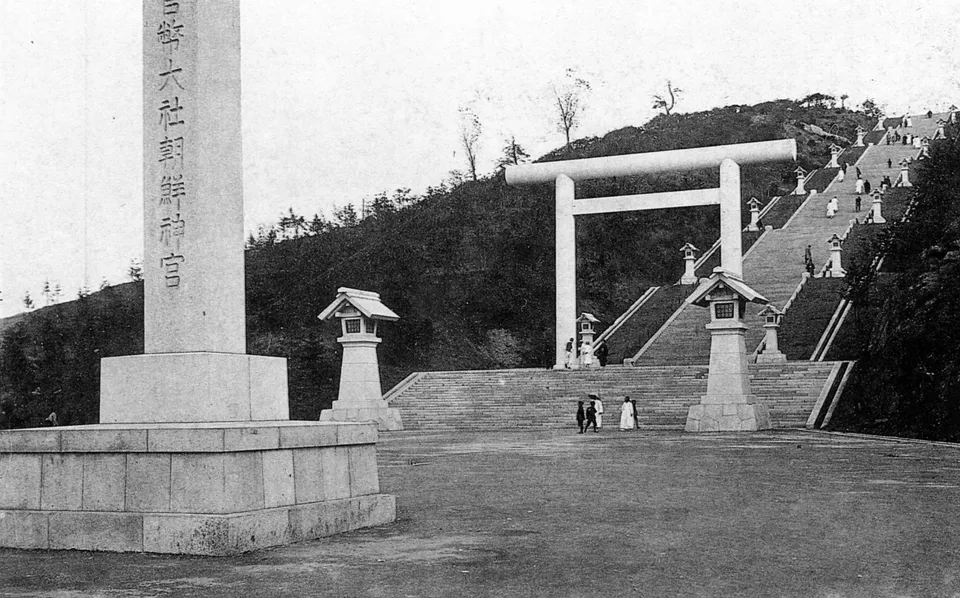
Chōsen Jingū on Namsan, Seoul, where Koreans were forced to worship

Unknown author · Public domain · Source

After the outbreak of the Sino-Japanese War in 1937, Governor-General Minami Jirō sought to erase Korean identity, claiming that Japan and Korea were one (naisen ittai) and shared common ancestors. Schools and offices had to recite the Oath of Imperial Subjects ("We are subjects of the Great Japanese Empire"), every township got a Shinto shrine for compulsory worship, and people had to bow toward the palace in Tokyo. Christian schools that refused shrine worship were closed.

The Third Education Ordinance (1938) made Korean an elective, effectively ending its teaching; in 1941 primary schools were renamed "national schools" (for imperial subjects), and the Fourth Ordinance (1943) abolished Korean-language classes. The Chosun Ilbo and Dong-A Ilbo were closed in 1940. Surveillance and preventive-detention ordinances for "thought criminals" (1936, 1941) kept activists under watch or in custody.

The map in 1937

OpenFreeMap © OpenMapTiles © OpenStreetMap contributors

States and rulers at the time
Korea under Japanese rule — Governor-General Minami Jirō
Japan · ruling power — Emperor Shōwa
Places
Site of the Government-General Building

People

  • Minami Jirō1874 – 1955

    leader · Seventh Governor-General of Korea, who pushed "Japan and Korea as one", imperial-subject policies and the name-change order

Before and after

Themes that include this event

  • World War II and Korea1937 – 1945

    Wartime mobilization and exploitation, independence armies, from the Cairo Declaration to liberation

  • Educational Institutions Through the AgesAD 372 – 1943

    From the Taehak and Gukhak to the Gukjagam and Seonggyungwan, modern schools and the colonial education ordinances — state schools that trained officials and the private schools that filled the gaps

  • Republican China and Imperial Japan1912 – 1949

    The age when the Republic of China, born of the 1911 Revolution, passed through warlord division, the May Fourth Movement, the United Front and the Northern Expedition, fought Japan’s invasion and split in civil war — as Japan moved from Taishō democracy through the Manchurian Incident and military coups to the war in China and the Co-Prosperity Sphere, and colonized Korea resisted through the March First Movement and armed struggle