Politics22 June 1965

Treaty on Basic Relations between Korea and Japan

Amid fierce protests (the June 3 protests), South Korea and Japan established diplomatic relations; the treaty contained no apology or reparations for colonial rule.
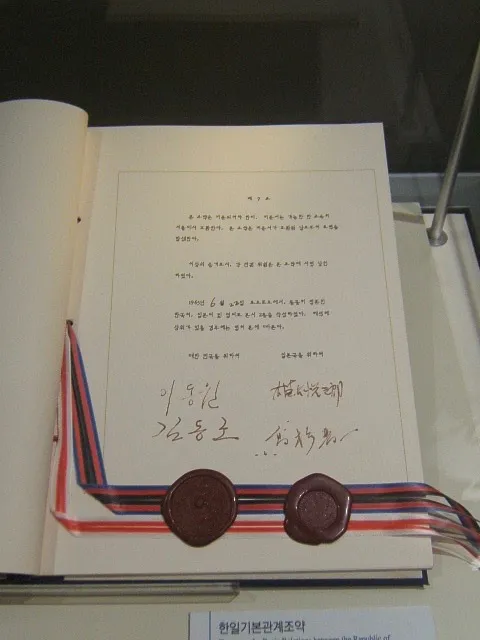
Copy of the Treaty on Basic Relations between Japan and the Republic of Korea, with the signatures of Lee Tong-won, Kim Dong-jo, Shiina Etsusaburo and Takasugi Shin’ichi — National Museum of Korean Contemporary History

Motoko C. K. · CC0 · Source

Needing funds for development, the government pressed for normalization with Japan, which the US also wanted for trilateral cooperation. The 1962 Kim–Ōhira memo secretly fixed the amount of claims funds. In 1964 large protests against "humiliating diplomacy" broke out, and the government declared martial law in Seoul on 3 June.

The treaty and its agreements were signed in Tokyo on 22 June 1965. Japan agreed to provide US$300 million in grants and $200 million in loans among other funds. The treaty contained no apology or reparations for colonial rule, and questions such as redress for the "comfort women" were left open.

The map in 1965

OpenFreeMap © OpenMapTiles © OpenStreetMap contributors

States and rulers at the time
South Korea · signatory — President Park Chung-hee
Japan · signatory — Emperor Shōwa

People

  • Park Chung-hee1917 – 1979

    related figure · 5th–9th President (1963–1979). Led the May 16 coup, the five-year economic plans and the Yushin system; killed in the October 26 incident

Before and after

Earlier
1964 June 3 Protests