Economy1565 – 1815

Manila Galleon Trade

Also called: Manila–Acapulco galleons, Founding of Manila

Spain found a return route across the Pacific from the Philippines to Mexico and founded Manila. For 250 years galleons crossed the Pacific, exchanging American silver for Chinese silk and porcelain.
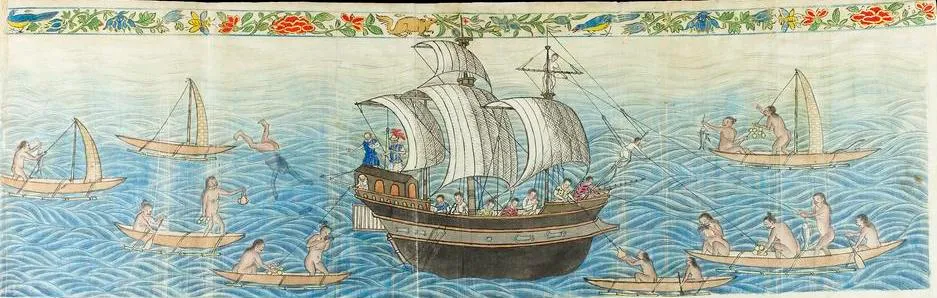
Chamorro canoes meeting a Manila galleon in the Mariana (Ladrones) Islands — Boxer Codex, c. 1590

Boxer Codex (1590) - Unknown Spanish Author/Compiler with Likely Chinese Artist from Spanish Colonial Manila, Philippines, circa 1590 AD. · Public domain · Source

In 1565 Legazpi settled at Cebu in the Philippines, and the friar Urdaneta, sailing with him, found the return route to Mexico on the westerlies and currents of the north Pacific. Manila was founded in 1571, and from the next year galleons sailed annually between Acapulco and Manila. American silver was traded in Manila for silk and porcelain brought by Fujianese merchants, and this silver drove much of the Ming economy. For the first time Asia, the Americas and Europe were joined in a single maritime trading network. The trade lasted until 1815.

The map in 1565

OpenFreeMap © OpenMapTiles © OpenStreetMap contributors

States and rulers at the time
Spanish East Indies · established
Viceroyalty of New Spain
Ming — Jiajing Emperor
Places
Manila, Acapulco

People

  • Miguel López de Legazpi1502 – 1572

    leader · Spanish conquistador who founded the first settlement in the Philippines at Cebu in 1565 and Manila in 1571, becoming the first governor

  • Andrés de Urdaneta1498 – 1568

    participant · Spanish friar and navigator who found the eastward return route across the Pacific from the Philippines to America (the tornaviaje) in 1565

Before and after

Themes that include this event

  • The Age of Discovery1415 – 1600

    From Ceuta to the Manila galleons — two centuries in which European ships crossed the oceans and bound the world together by sea

  • Ming, Qing and Edo Japan1500 – 1800

    The age when the Ming, shaken by northern raiders, southern pirates and the silver economy, fell to Li Zicheng’s rebels, and the Manchu Qing reached its greatest extent and prosperity under Kangxi, Yongzheng and Qianlong — as Japan was unified out of the Warring States into the Edo shogunate’s bakuhan order and closed country, and Joseon, after two great wars, met its neighbours through embassies to Edo and the Northern Learning