Exploration1271 – 1295

Travels of Marco Polo

Also called: The Travels of Marco Polo, Il Milione

The Venetian merchant Marco Polo came to Yuan China with his father and uncle and stayed seventeen years in Kublai’s service. The book he left, The Travels, introduced the East to Europe.
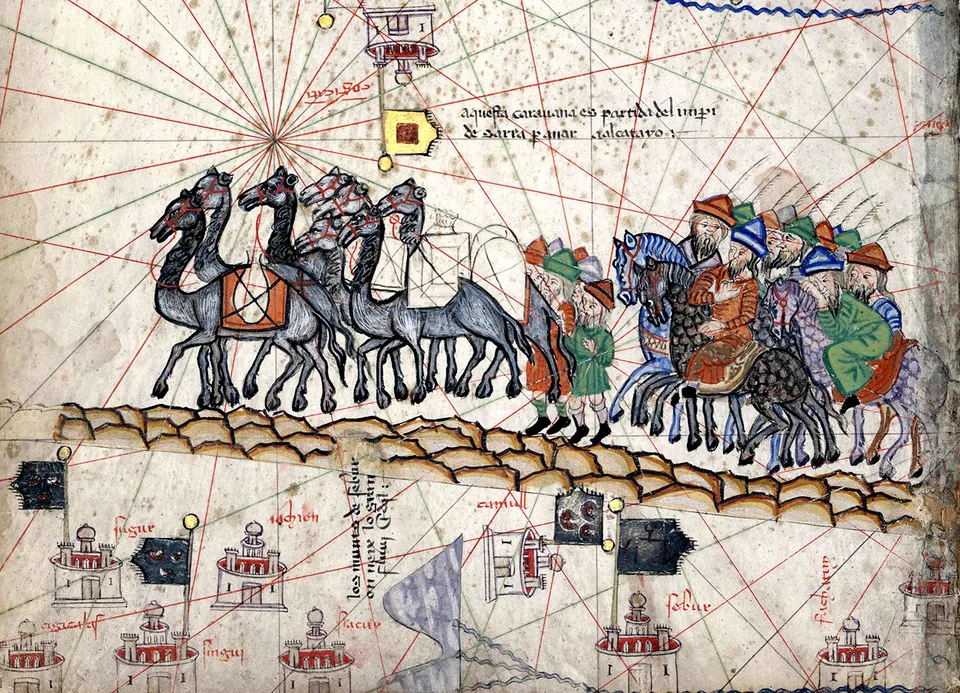
A caravan on the Silk Road from the Catalan Atlas of 1375, often said to show the Polo party

Abraham Cresques, Atlas catalan · Public domain · Source

Leaving Venice in 1271, Marco Polo followed the Silk Road and reached Shangdu around 1275, and is said to have travelled widely in Kublai’s confidence. Around 1291 he left by sea, escorting a princess sent as a bride to the Ilkhanate, and returned to Venice in 1295. Captured in a war with Genoa, he dictated his story in prison to Rustichello — The Travels of Marco Polo (Description of the World). Its accounts of the splendour of Hangzhou (Quinsai), paper money and coal were later read by Columbus. Because Chinese records do not name him, some have doubted that he reached China, but most scholars accept the account.

The map in 1271

OpenFreeMap © OpenMapTiles © OpenStreetMap contributors

States and rulers at the time
Republic of Venice
Places
Shangdu (Xanadu), Lin’an (Hangzhou)

People

  • Marco Polo1254 – 1324

    leader · Venetian merchant who spent seventeen years in Yuan China and on his return left The Travels of Marco Polo

  • Kublai Khan (Emperor Shizu of Yuan)1215 – 1294

    related figure · Fifth Great Khan and founder of the Yuan dynasty, who made peace with Goryeo and launched the invasions of Japan

Before and after

Related works

Themes that include this event

  • The Mongol Conquests1206 – 1294

    From the rise of Genghis Khan to the Yuan conquest of the Song — eighty years in which the Mongols swept Eurasia from Goryeo to Hungary