Conflict1756 – February 1763

Seven Years’ War

Also called: Seven Years War, Diplomatic Revolution, French and Indian War, Treaty of Paris (1763)

In 1756–1763 Austria, seeking to regain Silesia, allied with France and Russia against Prussia, while Britain and France fought for colonies in North America and India; Britain defeated France and won colonial supremacy.
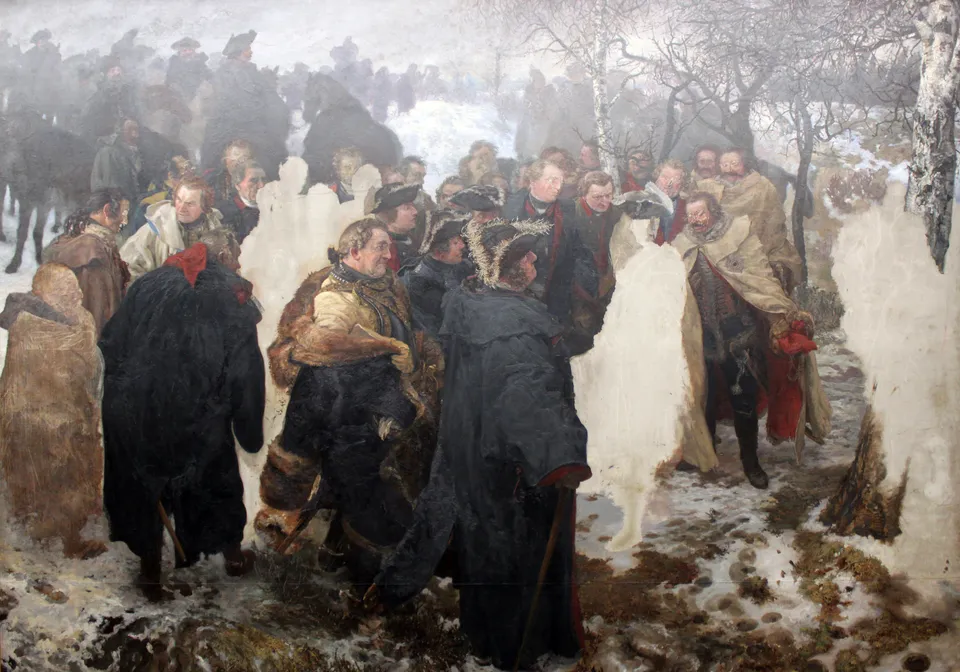
Frederick the Great addressing his generals before the Battle of Leuthen (1757) — painting by Adolph Menzel, 1859–1861

Adolph von Menzel · Public domain · Source

Through the “Diplomatic Revolution” (1756) Maria Theresa allied with her old enemy France and drew in Russia as well to encircle Prussia. Backed by Britain, Frederick II struck first at Saxony in 1756 and won at Leuthen (1757), but was badly defeated at Kunersdorf (1759) and his capital was in danger. He survived when Empress Elizabeth of Russia died in 1762 and her successor Peter III, an admirer of Frederick, made peace, and the Treaty of Hubertusburg (1763) left him Silesia.

Overseas, Britain fought France in the French and Indian War, taking Quebec (1759), and also drove French power out of India. By the Treaty of Paris (1763) Britain gained Canada, Louisiana east of the Mississippi and Spanish Florida, securing colonial supremacy.

Fought across several continents, the war is sometimes called the “first world war”. When Britain taxed its colonies to pay its war debts, the American Revolution followed, and France’s financial crisis led to the French Revolution. In 1762, during the war, King Yeongjo of Joseon had Crown Prince Sado shut in a rice chest to die (the Imo Incident).

The map in 1756

OpenFreeMap © OpenMapTiles © OpenStreetMap contributors

States at the time
Kingdom of Prussia · belligerent
Great Britain · belligerent
Habsburg Monarchy · belligerent
France · belligerent
Russia · belligerent
Spain · belligerent

People

  • Frederick the Great1712 – 1786

    commander · King of Prussia (r. 1740–1786) who seized Silesia and made Prussia a great power — an enlightened despot who called the ruler “the first servant of the state”

  • Maria Theresa1717 – 1780

    monarch · Habsburg heiress who ruled Austria, Hungary and Bohemia (1740–1780), fighting the War of the Austrian Succession and the Seven Years’ War while reforming her realm

Before and after

Themes that include this event

  • Islamic Empires and the Atlantic World1500 – 1800

    Three centuries in which the Ottomans of Suleiman I, the Mughals of Akbar and the Safavids of Abbas I flourished and then faltered, while across the Atlantic the slave trade and colonies transformed the Americas, leading to American independence

  • Reformation and Absolutism1517 – 1796

    From Luther’s Ninety-five Theses to Catherine the Great — the wars of religion of a divided Christendom ended at Westphalia, and absolute monarchs armed with divine right, standing armies, bureaucracies and mercantilism, followed by the enlightened despots of eastern Europe, contended for the balance of power among sovereign states