Sigurd and Fáfnir
Also called: Sigurd, Siegfried, Fafnir, Völsunga saga, Andvaranaut
A legend handed down over the centuries.
A Norse heroic legend told in the 13th-century Icelandic Völsunga saga and the Eddic poems Reginsmál and Fáfnismál. Urged on by the smith Regin, the hero Sigurd kills Fáfnir, who has become a dragon; tasting the blood of its heart, he understands the speech of birds and kills the treacherous Regin.
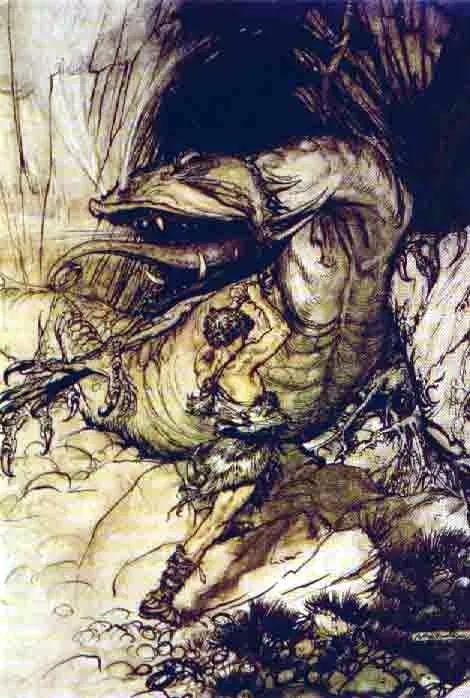
Arthur Rackham · Public domain · Source
This Norse heroic legend is told in the Völsunga saga, written in 13th-century Iceland, in the Eddic poems Reginsmál and Fáfnismál, and in Snorri’s Prose Edda. Though the sources date from the Christian era, the Ramsund carving in Sweden (c. 1030) shows the same scenes, proving the story was well known in the Viking Age. In the German Nibelungenlied (c. 1200) the same hero appears as Siegfried.
When the gods Odin, Loki and Hœnir killed Ótr, who had taken the shape of an otter, his father Hreiðmarr demanded compensation. Loki seized gold from the dwarf Andvari, who laid a curse on the last ring. Fáfnir killed his father for the gold, became a dragon and guarded the hoard; his brother Regin, foster-father of Sigurd, reforged a broken blade into the sword Gram and set Sigurd to kill the dragon.
Sigurd dug a pit in the path the dragon took to water and stabbed it from below. Roasting its heart for Regin, he burned his finger and put it in his mouth; at once he understood the birds, who warned that Regin meant to kill him. Sigurd beheaded Regin and loaded the treasure onto his horse Grani. The cursed gold later leads to the tragedy of Sigurd, Brynhildr and Guðrún.