Politics28 June 1919

Treaty of Versailles

Also called: Versailles Treaty

The peace treaty between the Allies and Germany signed in the Hall of Mirrors at Versailles. Germany accepted responsibility for the war, lost territory and colonies, had its armed forces restricted and was saddled with huge reparations.
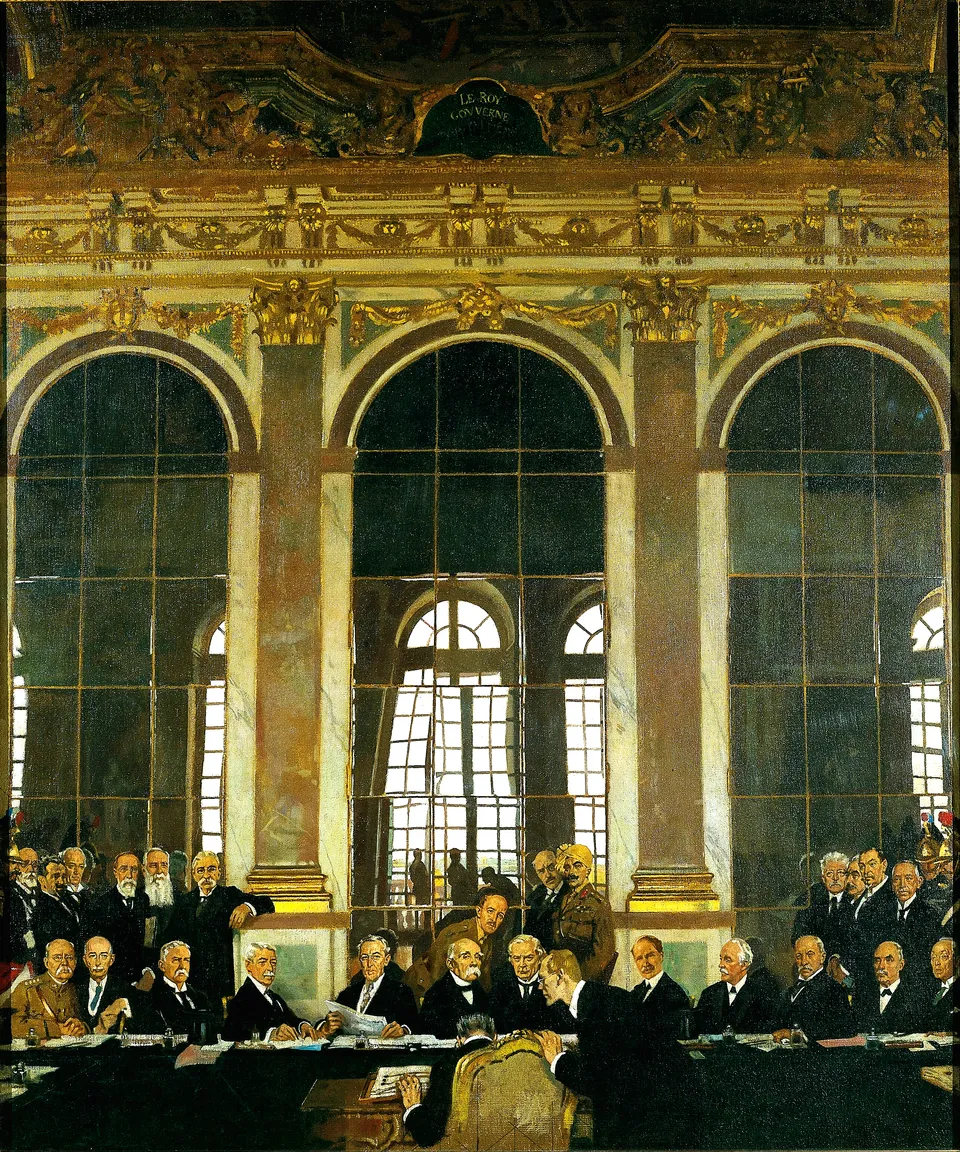
William Orpen, The Signing of Peace in the Hall of Mirrors, Versailles, 28 June 1919

William Orpen · Public domain · Source

On 28 June 1919, five years to the day after the Sarajevo assassination, German delegates signed the treaty in the Hall of Mirrors at Versailles — the very room where the German Empire had been proclaimed 48 years earlier. Germany had been shut out of the negotiations and had to accept the terms as they stood.

Germany accepted responsibility for the war (Article 231) and returned Alsace-Lorraine to France; the Polish Corridor and the Free City of Danzig cut East Prussia off from the rest of the country, and all overseas colonies were lost. The army was cut to 100,000 men, with no conscription, air force, submarines or tanks, and the Rhineland was demilitarized. Reparations were fixed in 1921 at 132 billion gold marks.

Germans denounced the treaty as a dictated peace. The heavy reparations weighed on the economy, and the call to overturn the treaty helped the Nazis grow. The US Senate refused to ratify it, and the United States never joined the League of Nations.

The map in 1919

OpenFreeMap © OpenMapTiles © OpenStreetMap contributors

States and rulers at the time
Germany · defeated
France · signatory
Great Britain · signatory
United States · signatory — President Woodrow Wilson
Italy · signatory
Japan · signatory — Emperor Taishō
Places
Palace of Versailles

People

  • Georges Clemenceau1841 – 1929

    diplomat · French prime minister (1906–1909, 1917–1920), nicknamed “the Tiger”, who led France through the last year of the war and, as president of the Paris Peace Conference, pressed for harsh terms on Germany

  • Woodrow Wilson1856 – 1924

    diplomat · 28th US president (1913–1921) who took America into the war in 1917 and proclaimed national self-determination and a League of Nations in his Fourteen Points; Nobel Peace Prize 1919

  • David Lloyd George1863 – 1945

    diplomat · British prime minister (1916–1922) who introduced social insurance as chancellor, led the wartime coalition and represented Britain at the Paris Peace Conference

Before and after

Themes that include this event

  • World War I and the Russian Revolution1908 – 1923

    From the Balkan crises to a war of trenches and total mobilization that toppled four empires; the Russian Revolution it unleashed, which created the first socialist state; and the Versailles settlement of national self-determination and the League of Nations