Paris Peace Conference
Also called: Versailles system, Versailles Peace Conference
Delegates of the victorious powers met in Paris to draw up the peace treaties with the defeated states. Led by Wilson, Clemenceau and Lloyd George, the conference created the Versailles settlement.
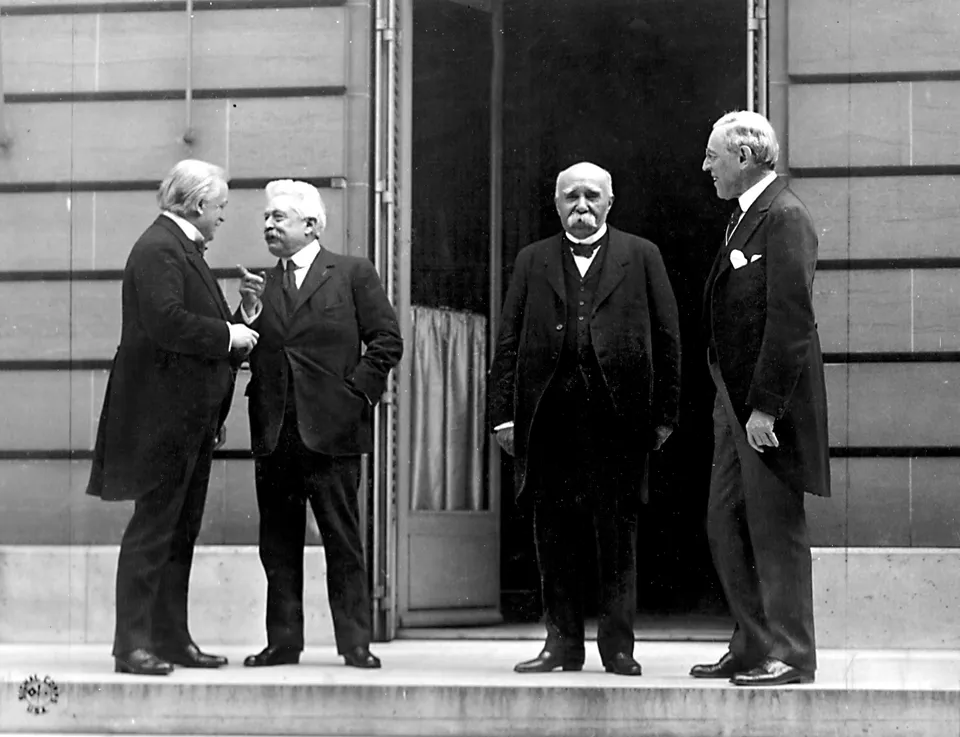
Edward N. Jackson (US Army Signal Corps) · Public domain · Source
On 18 January 1919 delegates of nearly thirty countries gathered in Paris; the defeated powers and Soviet Russia were not invited. The key decisions were made by Wilson of the United States, Clemenceau of France, Lloyd George of Britain and Orlando of Italy. Wilson championed the ideals of the Fourteen Points, but Clemenceau demanded terms harsh enough that Germany could never threaten France again, and Britain and Italy pursued their own interests.
The conference produced treaties with Germany (Versailles), Austria (Saint-Germain), Bulgaria (Neuilly), Hungary (Trianon) and the Ottoman Empire (Sèvres). Under the principle of self-determination new states such as Poland, Czechoslovakia and Yugoslavia appeared in Eastern Europe, but the colonies of the defeated powers and the Arab lands became mandates of the victors. The resulting international order is called the Versailles system.
Self-determination did not reach the victors’ own colonies. Kim Kyu-sik of the Korean Provisional Government submitted a petition for independence, but the conference ignored it, and when the German rights in Shandong were handed to Japan, China erupted in the May Fourth Movement. Japan’s proposed racial equality clause was also rejected.