Voyagers enter interstellar space
Also called: Voyager 1 heliopause crossing
On 25 August 2012 Voyager 1, 121 AU (18 billion km) from the Sun, became the first human-made object to cross the heliopause — the edge of the solar wind — into the space between the stars. Voyager 2 followed on 5 November 2018.
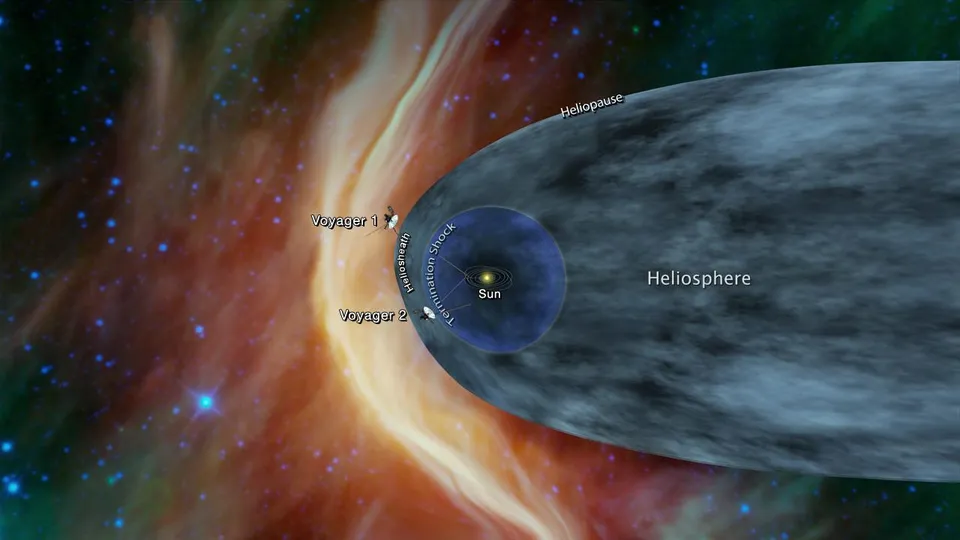
NASA/JPL-Caltech · Public domain · Source
The Sun blows a wind of charged particles in every direction, and the bubble it fills before the thin matter between the stars stops it is called the heliosphere. Voyager 1 passed the termination shock, where the solar wind abruptly slows, in 2004; on 25 August 2012 the density of particles around it jumped fortyfold. It had crossed the heliopause, the edge of the bubble. A year later, after studying the data, NASA announced that a human-made object had entered interstellar space for the first time.
On 5 November 2018 Voyager 2 crossed at 119 AU. Its plasma instrument — the one that failed on Voyager 1 in 1980 — still worked, and measured the crossing directly. Passing the edge in the north and the south, the two probes revealed the bubble’s shape and thickness.