Pale Blue Dot
Also called: Family Portrait, Voyager family portrait
On 14 February 1990 Voyager 1, six billion kilometres out, turned its camera back and photographed the planets. In one frame the Earth was a single dot in a shaft of sunlight. Carl Sagan called it the Pale Blue Dot.
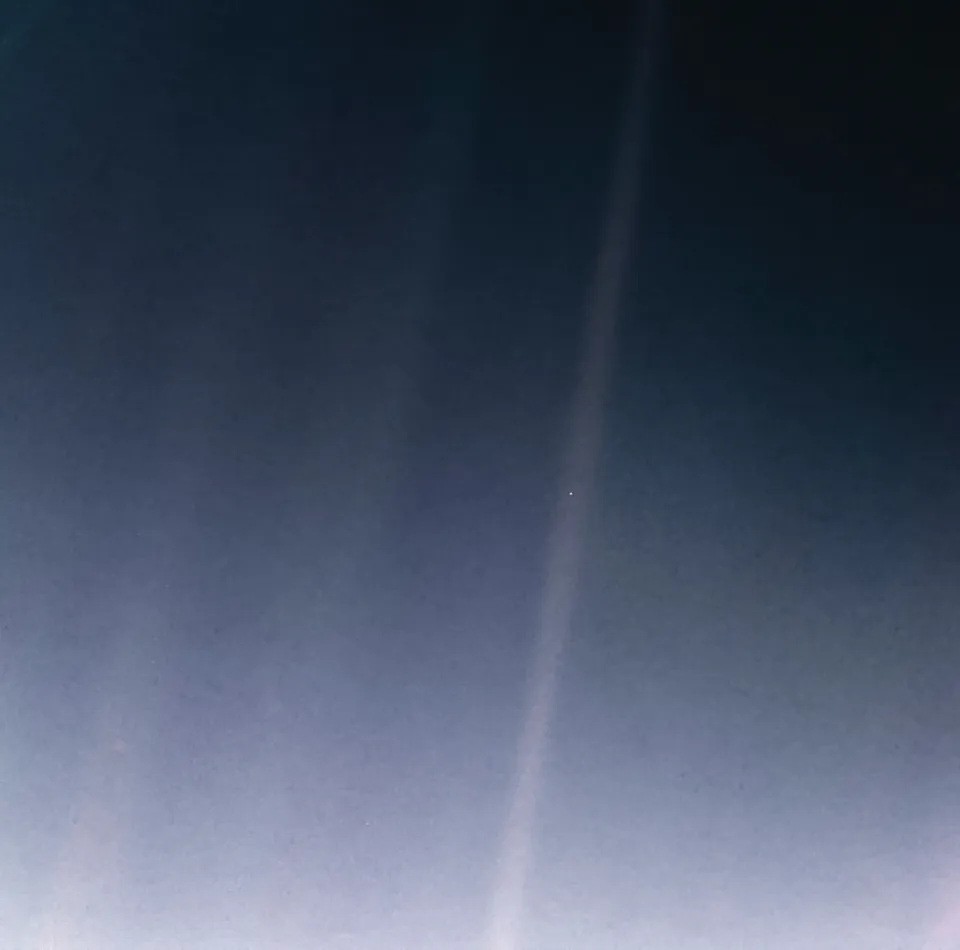
NASA/JPL-Caltech · Public domain · Source
With Neptune behind them and no more use for the cameras, Carl Sagan persuaded NASA to turn the probe round one last time to photograph the Earth. Many objected that pointing the camera near the Sun could damage it. On 14 February 1990 Voyager 1, 32° above the plane of the planets, took sixty frames of a “family portrait” showing Venus, Earth, Jupiter, Saturn, Uranus and Neptune. Voyager’s cameras were never switched on again.
The Earth was a dot smaller than one pixel, floating in a band of sunlight scattered inside the camera. In his 1994 book Pale Blue Dot, Sagan reflected that everyone we have known and all of history happened on that tiny dot, and argued that we should deal more kindly with one another and cherish the only home we have ever known.