Science20 August 1977 –

Voyager program

Also called: Voyager, Voyager mission, Voyager probes

Launched by the United States in 1977, the uncrewed probes Voyager 1 and 2 flew past Jupiter, Saturn, Uranus and Neptune, giving the first close looks at them, then crossed the edge of the solar wind into interstellar space. Nearly fifty years on they still talk to Earth.
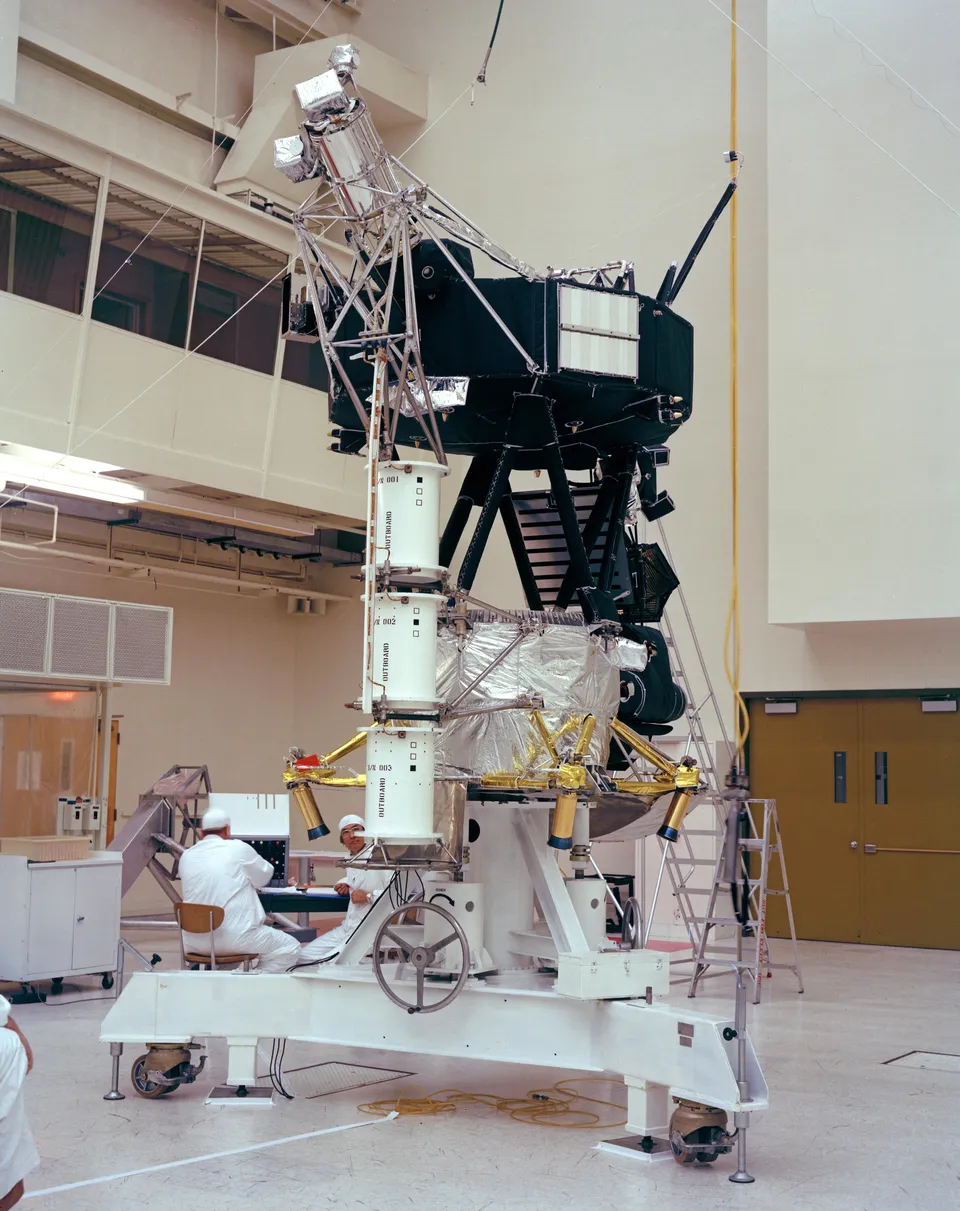
A Voyager test model — the white dish is the 3.7 m high-gain antenna, JPL, 1976

NASA/JPL · Public domain · Source

In the mid-1960s Gary Flandro at the Jet Propulsion Laboratory found that in the late 1970s Jupiter, Saturn, Uranus and Neptune would line up on one side of the Sun. By borrowing direction and speed from each planet’s gravity, a single spacecraft could visit all four — an arrangement that comes round only once in some 175 years. The plan was cut back for lack of money, but in 1977 two identical probes, Voyager 1 and 2, set out.

Voyager 1 passed Jupiter (1979) and Saturn (1980); its close look at Saturn’s moon Titan bent it up out of the plane of the planets. Voyager 2 passed Jupiter (1979) and Saturn (1981), then Uranus (1986) and Neptune (1989) — still the only spacecraft to have visited those two. Each carries the Golden Record, a gilded disc of the sounds and pictures of Earth.

Their planetary tour over, the two kept heading out of the heliosphere. Voyager 1 in 2012 and Voyager 2 in 2018 crossed the heliopause, where the solar wind ends, into interstellar space. Their nuclear batteries weaken every year and instruments are being switched off one by one, but both still signal home through the big dishes of NASA’s Deep Space Network.
The map in 1977

OpenFreeMap © OpenMapTiles © OpenStreetMap contributors

States and rulers at the time
United States — President Jimmy Carter
Places
Jet Propulsion Laboratory, Cape Canaveral Launch Complex 41, Canberra Deep Space Communication Complex

People

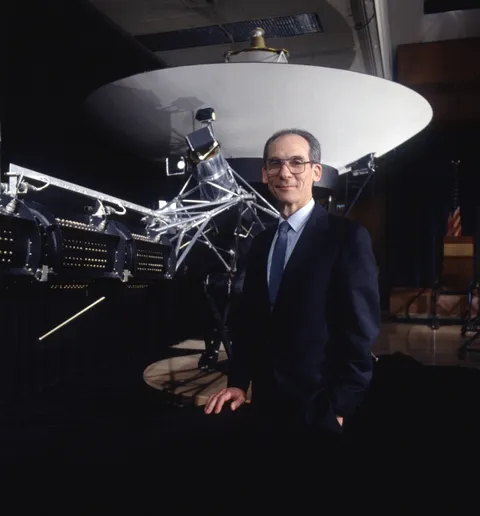
  • Edward Stone1936 – 2024

    key figure · American physicist, project scientist of the Voyager mission for fifty years (1972–2022) and director of the Jet Propulsion Laboratory (1991–2001)

  • Gary Flandro

    key figure · American aerospace engineer who, as a summer researcher at JPL in 1965, worked out that in the late 1970s the four outer planets would line up so that one spacecraft could visit them in turn — the Grand Tour

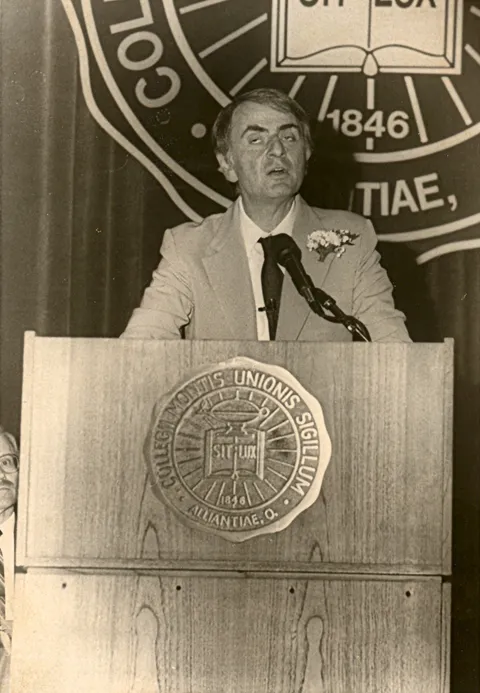
  • Carl Sagan1934 – 1996

    participant · American astronomer and writer who led the making of the Voyager Golden Record and persuaded NASA to turn Voyager 1 around in 1990 to photograph the Earth from six billion kilometres — the Pale Blue Dot. Author of Cosmos

7 parts of this event

  1. 1

    Voyager 2 left Cape Canaveral on 20 August 1977 and Voyager 1 on 5 September, each on a Titan IIIE-Centaur rocket and each carrying the Golden Record, a disc of the sounds and pictures of Earth.

  2. 2

    Voyager 1 passed Jupiter on 5 March 1979 and Voyager 2 on 9 July. They found erupting volcanoes on the moon Io — the first active volcanoes seen beyond the Earth — and Jupiter’s faint ring.

  3. 3
    1980 – 1981Voyagers at Saturn

    Voyager 1 passed Saturn and its moon Titan in November 1980, Voyager 2 passed Saturn in August 1981. The close look at Titan bent Voyager 1 up out of the plane of the planets, ending its planetary tour.

  4. 4

    On 24 January 1986 Voyager 2 became the first — and so far the only — spacecraft to pass Uranus. It found ten new moons and two new rings.

  5. 5

    On 25 August 1989 Voyager 2 passed 5,000 km above Neptune’s north pole, the first close look at the last of the big planets. On its moon Triton it found geysers erupting from under the ice.

  6. 6

    On 14 February 1990 Voyager 1, six billion kilometres out, turned its camera back and photographed the planets. In one frame the Earth was a single dot in a shaft of sunlight. Carl Sagan called it the Pale Blue Dot.

  7. 7

    On 25 August 2012 Voyager 1, 121 AU (18 billion km) from the Sun, became the first human-made object to cross the heliopause — the edge of the solar wind — into the space between the stars. Voyager 2 followed on 5 November 2018.

Before and after

Themes that include this event

  • Space Exploration1957 – 2012

    From Sputnik, the first artificial satellite, to Apollo 11’s first landing on the Moon, Apollo 13’s return from behind it and the Voyagers, which passed the outer planets and went on into interstellar space — the paths of the people and probes that left the Earth