Voyagers at Jupiter
Voyager 1 passed Jupiter on 5 March 1979 and Voyager 2 on 9 July. They found erupting volcanoes on the moon Io — the first active volcanoes seen beyond the Earth — and Jupiter’s faint ring.
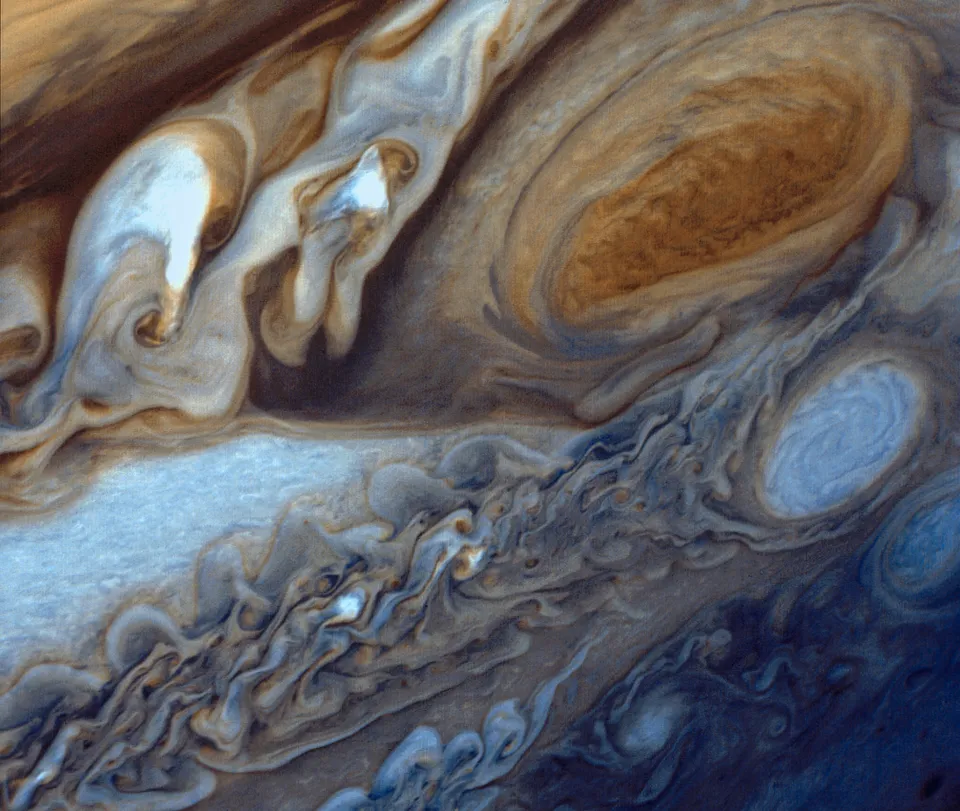
NASA, Caltech/JPL · Public domain · Source
On 5 March Voyager 1 passed 350,000 km from Jupiter’s centre; four months later Voyager 2 passed farther out and looked again. Their pictures showed for the first time, clearly and in motion, Jupiter’s bands and eddies and the Great Red Spot, a storm larger than the Earth.
The biggest surprise was Io. On 9 March Linda Morabito at the Jet Propulsion Laboratory spotted a plume rising beyond the moon’s edge: a volcano. Kneaded by the gravity of Jupiter and its other moons, Io’s interior is hot, and nine volcanoes were erupting at once — the first active volcanoes seen beyond the Earth. The smooth ice of Europa and a faint ring around Jupiter were also seen for the first time.
Both probes took speed from Jupiter’s gravity and headed for Saturn.