Science12 November 1980 and 26 August 1981

Voyagers at Saturn

Voyager 1 passed Saturn and its moon Titan in November 1980, Voyager 2 passed Saturn in August 1981. The close look at Titan bent Voyager 1 up out of the plane of the planets, ending its planetary tour.
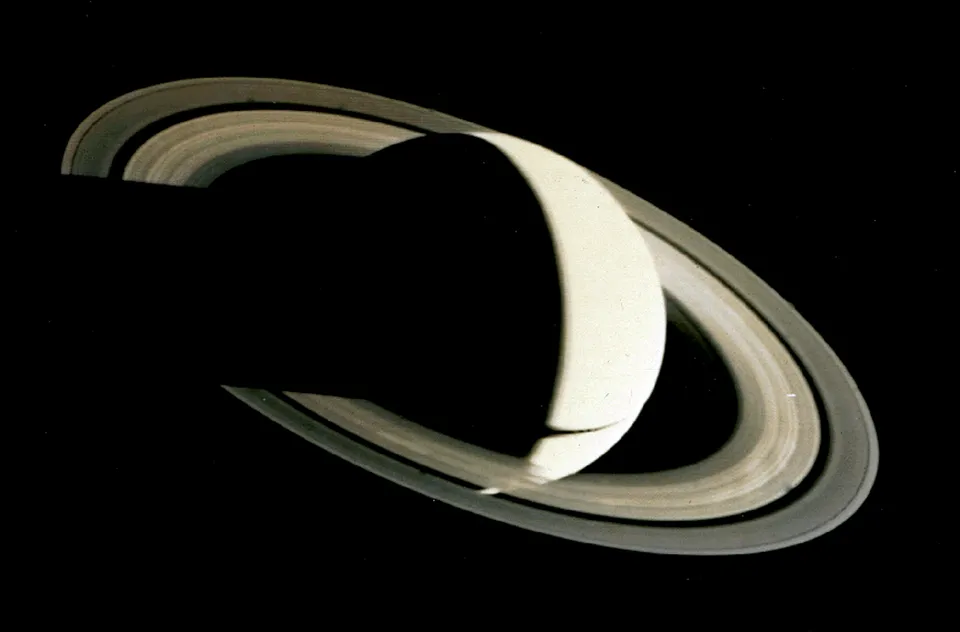
Crescent Saturn, looking back after the flyby — Voyager 1, November 1980

NASA · Public domain · Source

From Earth Saturn’s rings looked like a few bands; up close they turned out to be thousands of thin ringlets. The narrow outer F ring was twisted like a braid, held in place by small shepherd moons on either side.

Titan is the only moon in the solar system with a thick atmosphere, and scientists badly wanted to see it. On 12 November Voyager 1 passed a little over 4,000 km above it. The air was mostly nitrogen and the ground was hidden by a deep orange haze. Titan’s gravity flung Voyager 1 north, up out of the plane of the planets, and the chance to see Uranus and Neptune passed to Voyager 2.

Voyager 2 passed Saturn on 26 August 1981 and turned towards Uranus.
The map in 1980

OpenFreeMap © OpenMapTiles © OpenStreetMap contributors

States and rulers at the time
United States — President Jimmy Carter
Places
Jet Propulsion Laboratory

People

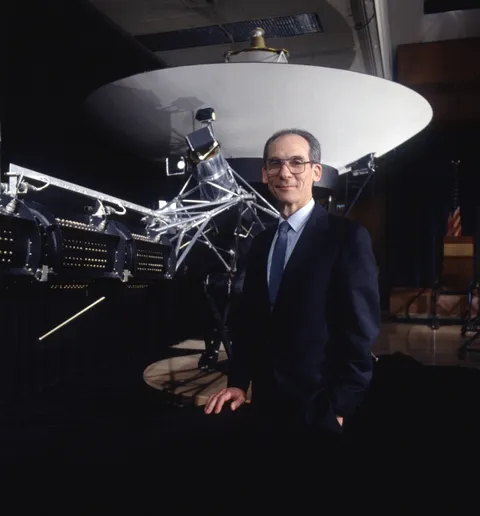
  • Edward Stone1936 – 2024

    key figure · American physicist, project scientist of the Voyager mission for fifty years (1972–2022) and director of the Jet Propulsion Laboratory (1991–2001)

Before and after

Themes that include this event

  • Space Exploration1957 – 2012

    From Sputnik, the first artificial satellite, to Apollo 11’s first landing on the Moon, Apollo 13’s return from behind it and the Voyagers, which passed the outer planets and went on into interstellar space — the paths of the people and probes that left the Earth