The Warring States and the Seven Powers
Also called: Warring States period, Seven Warring States
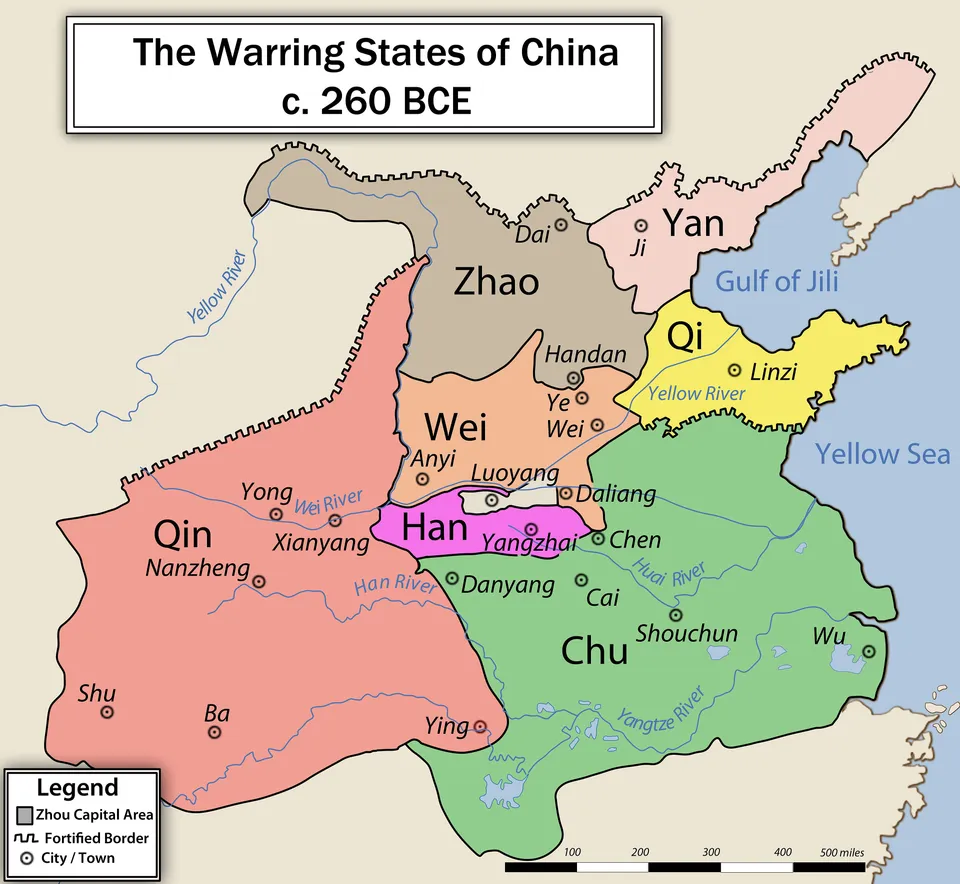
After Jin split into Han, Wei and Zhao, seven great states — Qin, Chu, Qi, Yan, Han, Wei and Zhao — fought for supremacy. Iron farm tools spread and farming, trade and crafts flourished.
Philg88 · CC BY-SA 3.0 · Source
In 403 BCE the Han, Wei and Zhao families, ministers of the state of Jin, divided it among themselves and were recognised as lords by the Zhou king. The time from then until the Qin unification is called the Warring States period, after the Strategies of the Warring States. Zhou authority vanished, the lords styled themselves kings, and the Seven Powers — Qin, Chu, Qi, Yan, Han, Wei and Zhao — fought one another with mass infantry armies.
Iron farm tools and ox-drawn ploughs spread widely, new land was cleared and output rose sharply. Clan communities broke down, small farming households became the basic unit of production, and kings ruled their people directly through appointed officials instead of nobles. Trade and crafts grew, cities expanded, and each state used its own bronze coins — knife money, spade money and round coins.
Yan in the northeast bordered Gojoseon and clashed with it (late 4th–early 3rd century BCE); the many Yan knife coins (mingdaoqian) found along the Yalu and Cheongcheon rivers show its contacts with Gojoseon. Qin, strengthened by the reforms of Shang Yang, destroyed the other six states and unified China in 221 BCE.