Ten-story Stone Pagoda at the Wongaksa Temple Site, Seoul
Also called: Wongaksa Pagoda
The marble pagoda (1467) of Wongaksa, which King Sejo built in the heart of Hanyang. Modelled on Goryeo’s Gyeongcheonsa pagoda, it is a rare Buddhist monument from Confucian Joseon.
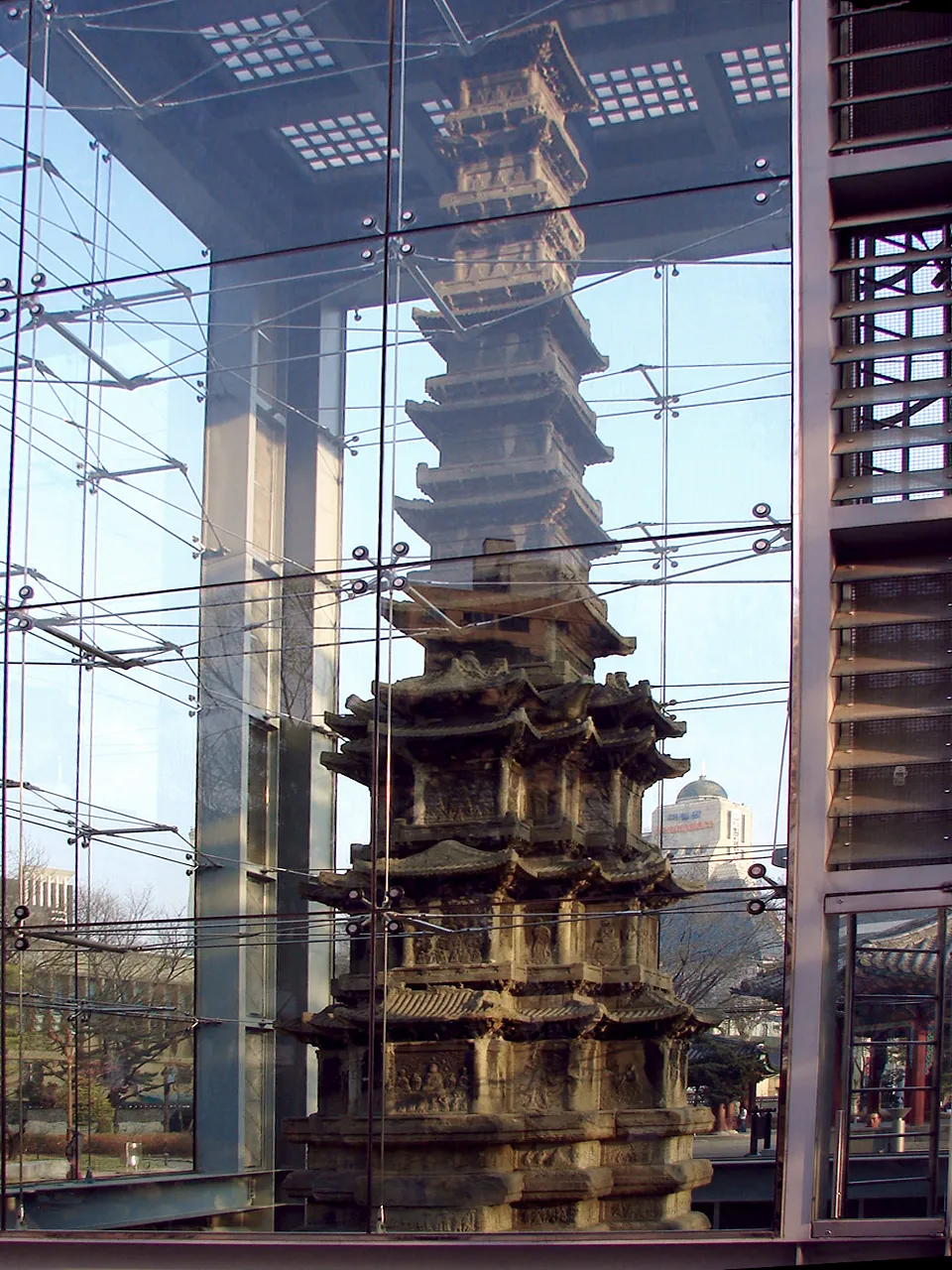
Steve46814 · CC BY-SA 3.0 · Source
King Sejo founded Wongaksa in the centre of Hanyang in 1465 and completed this ten-story pagoda in 1467, his 13th year. It is of grey marble, and its three-tier base — shaped like the character 亞 seen from above — and its stories are crowded with Buddhas, bodhisattvas and Buddhist tales. Its form and material so closely resemble Goryeo’s Yuan-influenced Gyeongcheonsa pagoda that it is thought to have been modelled on it. It is about 12 m tall.
Even in a Joseon that exalted Confucianism and suppressed Buddhism, the devout Sejo built Wongaksa and set up the Office for Publishing Buddhist Scriptures to translate sutras into Hangeul. The temple was abolished under Yeonsangun; only the pagoda remains, standing in a glass shelter in today’s Tapgol Park, the old temple site. It is a National Treasure, and exams pair it with the Gyeongcheonsa pagoda: Goryeo, Yuan influence, copied in Joseon.