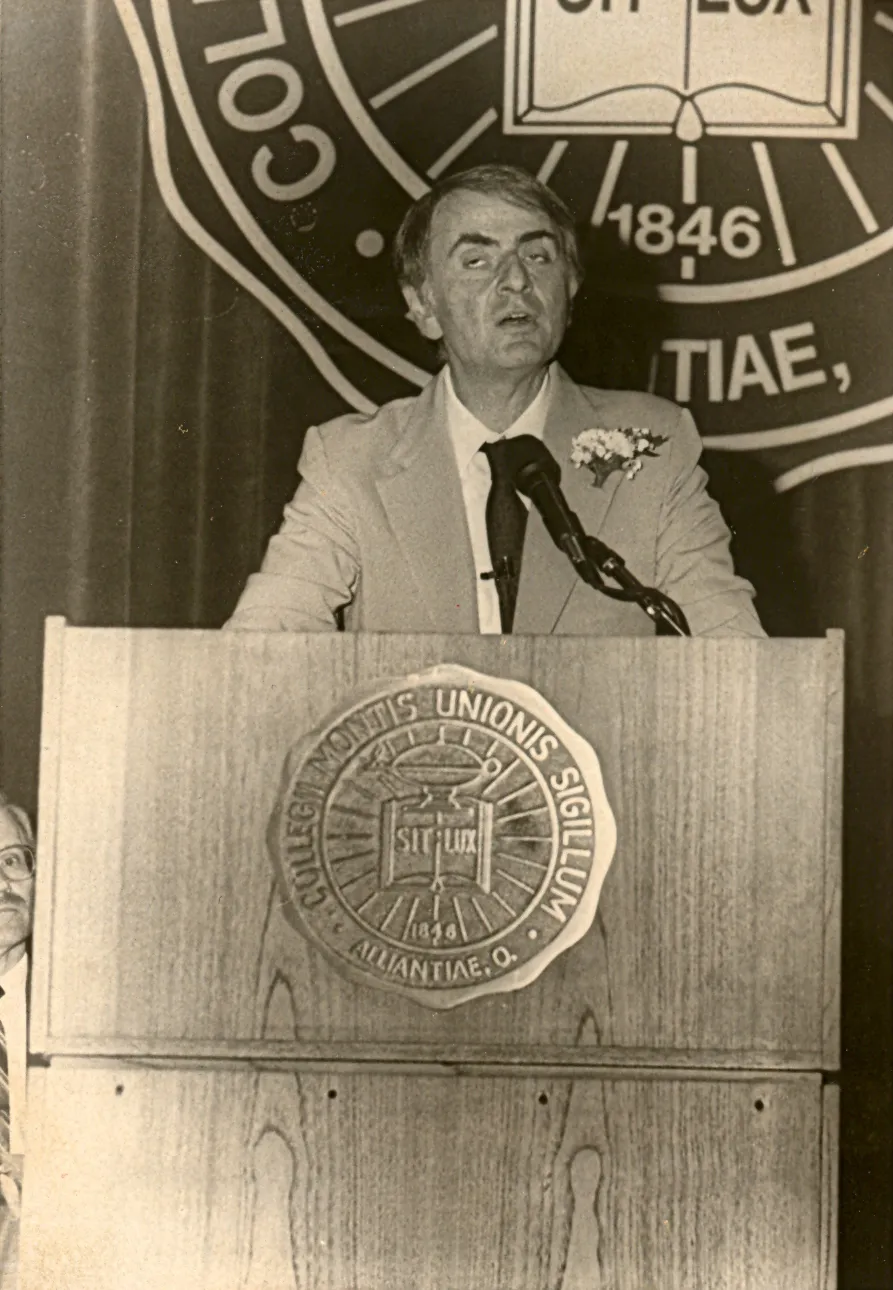
Person1934 – 1996
Carl Sagan
American astronomer and writer who led the making of the Voyager Golden Record and persuaded NASA to turn Voyager 1 around in 1990 to photograph the Earth from six billion kilometres — the Pale Blue Dot. Author of Cosmos
American astronomer and writer who led the making of the Voyager Golden Record and persuaded NASA to turn Voyager 1 around in 1990 to photograph the Earth from six billion kilometres — the Pale Blue Dot. Author of Cosmos
Voyager 2 left Cape Canaveral on 20 August 1977 and Voyager 1 on 5 September, each on a Titan IIIE-Centaur rocket and each carrying the Golden Record, a disc of the sounds and pictures of Earth.
Launched by the United States in 1977, the uncrewed probes Voyager 1 and 2 flew past Jupiter, Saturn, Uranus and Neptune, giving the first close looks at them, then crossed the edge of the solar wind into interstellar space. Nearly fifty years on they still talk to Earth.
On 14 February 1990 Voyager 1, six billion kilometres out, turned its camera back and photographed the planets. In one frame the Earth was a single dot in a shaft of sunlight. Carl Sagan called it the Pale Blue Dot.
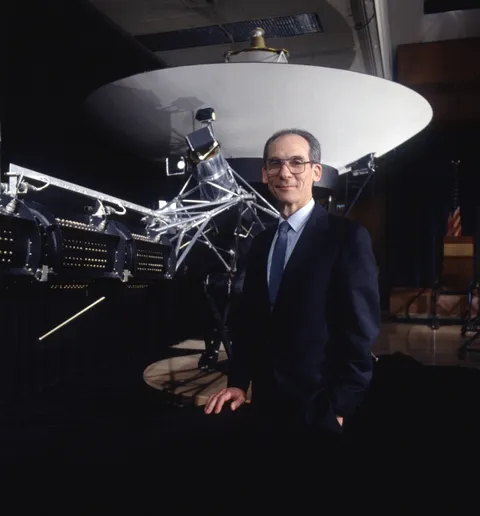
American physicist, project scientist of the Voyager mission for fifty years (1972–2022) and director of the Jet Propulsion Laboratory (1991–2001)
American aerospace engineer who, as a summer researcher at JPL in 1965, worked out that in the late 1970s the four outer planets would line up so that one spacecraft could visit them in turn — the Grand Tour
From Sputnik, the first artificial satellite, to Apollo 11’s first landing on the Moon, Apollo 13’s return from behind it and the Voyagers, which passed the outer planets and went on into interstellar space — the paths of the people and probes that left the Earth