Crossing of the Red Sea
Also called: Parting of the Red Sea, Crossing of the Reed Sea
A story told in religious scripture.
A story told in the Book of Exodus: before Pharaoh’s pursuing chariots, Moses stretched out his hand, the sea parted and the Israelites crossed on dry ground, and the returning waters drowned the Egyptian army. Where that sea was is unknown.
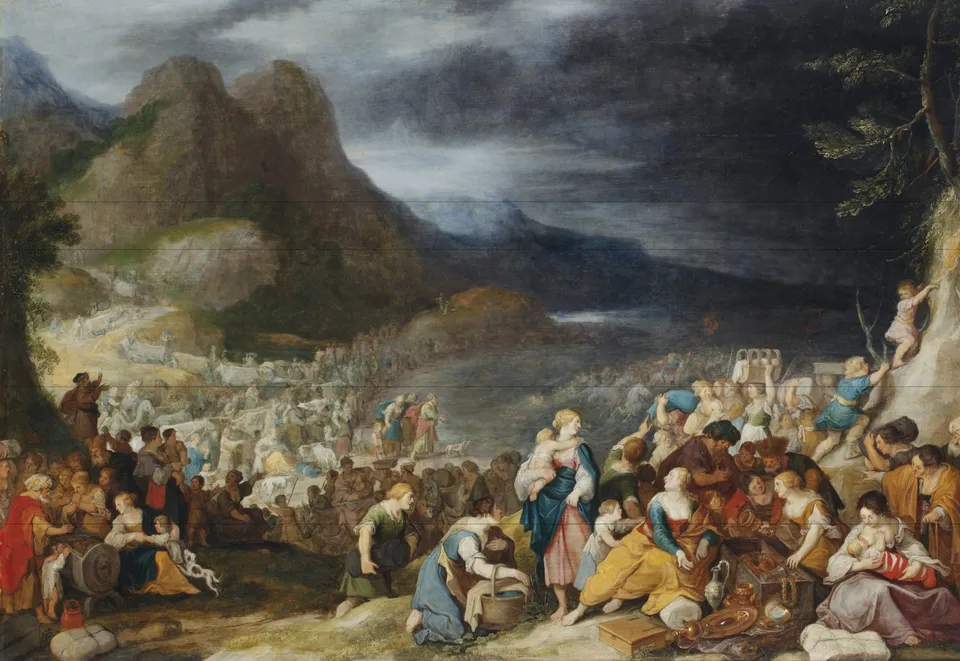
Hans Jordaens III · Public domain · Source
This is the story told in the Book of Exodus. Once the Israelites had gone, Pharaoh changed his mind and pursued them with six hundred chosen chariots. Camped by the sea before Pi-hahiroth, the Israelites had the sea ahead and the chariots behind. Moses stretched out his hand over the sea, a strong east wind blew all night and divided the waters, and the Israelites crossed on dry ground; the Egyptian army that followed was drowned as the waters returned. On the far shore Moses and Miriam sang (Exodus 15).
The Bible’s name for this sea is Yam Suph. The Greek Bible rendered it “Red Sea”, but the Hebrew means something closer to “Sea of Reeds”, and so there are several theories of where it was: the head of the Gulf of Suez, today’s Red Sea; the reedy marshes of the Bitter Lakes and Lake Timsah, where the Suez Canal now runs; shallow Lake Sirbonis (Bardawil) on the Mediterranean coast; and Nuweiba beach on the Gulf of Aqaba, favoured by those who place Mount Sinai in Arabia.
None has been confirmed by archaeology. Many scholars favour the Bitter Lakes area, which fits both the meaning “Sea of Reeds” and the geography of Egypt’s eastern frontier.