Discovery of the Laocoön Group
Also called: Laocoön and His Sons, Laocoon group
On 14 January 1506 a marble group of Laocoön and his two sons in the coils of serpents was unearthed in a vineyard on the Esquiline Hill in Rome. Pope Julius II bought it and placed it in the Belvedere court of the Vatican; it is still in the Vatican Museums.
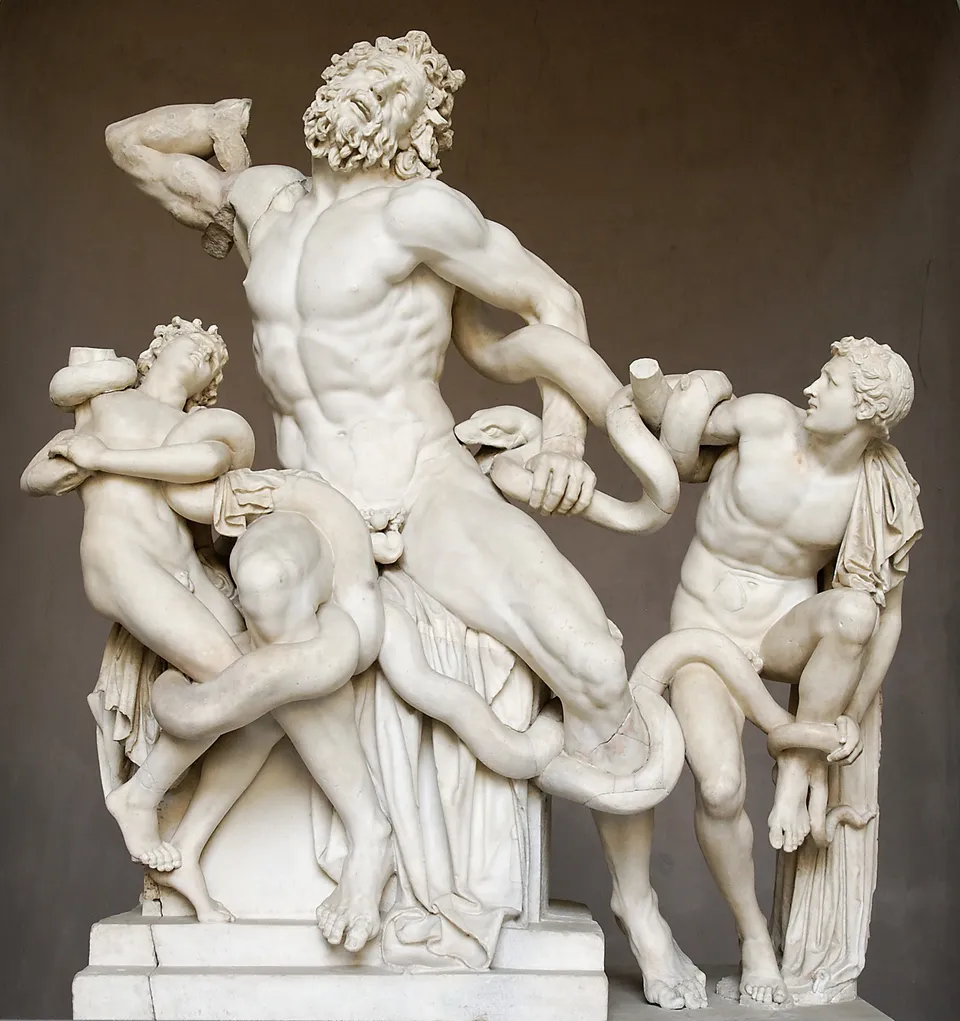
Hagesandros, Athenedoros, and Polydoros · Public domain · Source
On 14 January 1506 a large marble group came out of the ground in the vineyard of Felice de’ Fredis on the Esquiline Hill in Rome, near the basilica of Santa Maria Maggiore (accounts of the exact spot differ). Pope Julius II sent the architect Giuliano da Sangallo and Michelangelo to see it, and Sangallo at once recognised the Laocoön that Pliny the Elder had praised in his Natural History (Book 36) as standing in the house of the emperor Titus and surpassing any painting or bronze — the work of the Rhodian sculptors Hagesandros, Polydoros and Athanodoros. The pope bought it in March and set it up in the Belvedere statue court of the Vatican, an event the Vatican Museums count as their beginning.
Its bodies writhing in agony deeply influenced Michelangelo and other Renaissance and Baroque artists, and in the 18th century the German writer Lessing used it in his Laocoön (1766), an essay on the difference between poetry and the visual arts. Laocoön’s missing right arm was first restored stretched out straight, but in 1906 the archaeologist Ludwig Pollak found the original, bent arm in a Roman shop, and it was reattached in the restoration of the 1950s.
Though Pliny said it was carved from a single block, it is in fact made of several pieces. Whether it is a Roman copy of a Hellenistic bronze of about 200 BC or an original of around the 1st century BC is still debated. It stands today in the Octagonal Court of the Museo Pio-Clementino in the Vatican Museums.