Myths1200 BC – 187618 events

The Trojan War and the Odyssey

From the apple of discord to the Trojan Horse and the homecoming of Odysseus — the Greek myth in story order, alongside the real site of Troy, the making of the epics, the Laocoön group and Schliemann’s excavations
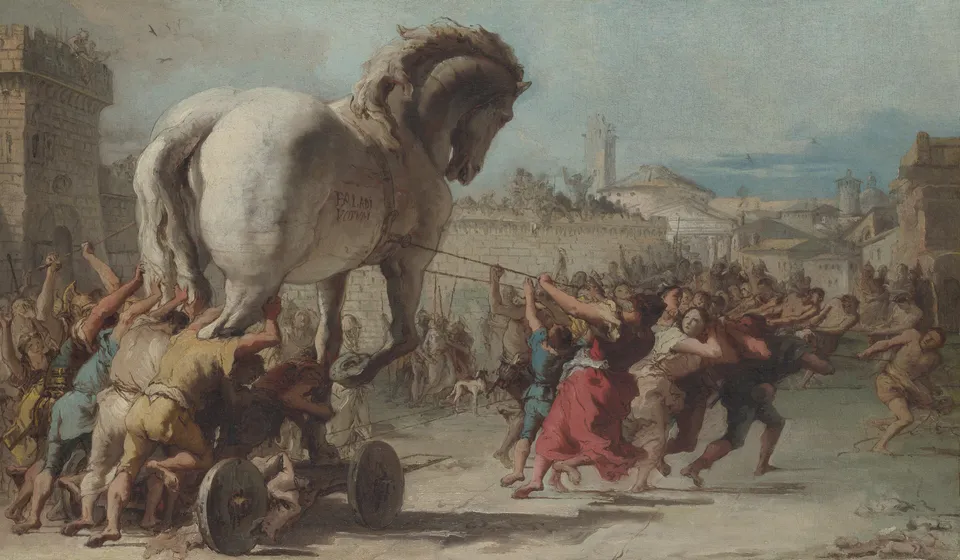
조반니 도메니코 티에폴로, 「트로이로 들어가는 목마의 행렬」, 1760년 무렵 — 런던 내셔널 갤러리

Giovanni Domenico Tiepolo · Public domain · Source

At a glance

StorySourceKind
Apple of discordCypria (fragments), HyginusMyth
Judgement of ParisCypria; Iliad 24Myth
Helen and ParisCypria; IliadMyth
Iphigenia at AulisCypria; EuripidesMyth
Wrath of AchillesIliadMyth
Death of AchillesAethiopis; Odyssey 24Myth
Trojan HorseOdyssey; Aeneid 2Legend
Death of LaocoönAeneid 2Legend
Laocoön group found (1506)Esquiline, Rome → VaticanHistory
Destruction of Troy (c. 1180 BC)Hisarlik, layer VIIaHistory
The CyclopsOdyssey 9Myth
CirceOdyssey 10Myth
The SirensOdyssey 12Myth
Calypso and the PhaeaciansOdyssey 5–8Myth
Penelope and the homecomingOdyssey 13–24Myth
The epics take shape (8th c. BC)Ionia; HomerHistory
Excavation of Troy (1871–1873)Schliemann at HisarlikHistory
Excavation of Mycenae (1876)Schliemann, Grave Circle AHistory

The theme on the map

OpenFreeMap © OpenMapTiles © OpenStreetMap contributors

18 events in this theme

  1. A Greek myth told in the epic Cypria and later mythographers. Eris, goddess of strife, left out of the wedding feast of the hero Peleus and the sea goddess Thetis, threw in a golden apple inscribed “to the fairest”, setting Hera, Athena and Aphrodite against one another.

  2. A Greek myth told in the Cypria and briefly mentioned in Book 24 of the Iliad. On Mount Ida the Trojan prince Paris had to choose the most beautiful of three goddesses, and chose Aphrodite, who promised him the most beautiful woman in the world.

  3. UndatedHelen and ParisLegend

    A Greek myth told in the Cypria and the Iliad. When Paris carried off Helen, wife of King Menelaus of Sparta, to Troy, Menelaus’ brother Agamemnon gathered the kings of Greece for an expedition against Troy.

  4. UndatedIphigenia at AulisLegend

    A Greek myth told in the Cypria and the tragedies of Aeschylus and Euripides. When Artemis in her anger stilled the winds and held the Greek fleet at the harbour of Aulis, Agamemnon sacrificed his daughter Iphigenia.

  5. A Greek myth sung in Homer’s Iliad. In the tenth year of the war Achilles, insulted by Agamemnon, withdraws from battle; when his friend Patroclus is killed by Hector he returns and kills Hector, and Priam, king of Troy, comes to ransom his son’s body.

  6. A Greek myth told in the lost epic Aethiopis and in Book 24 of the Odyssey. After killing the Amazon queen Penthesilea and the Ethiopian king Memnon, Achilles was killed by an arrow shot by Paris and guided by Apollo.

  7. 1184 BCThe Trojan HorseLegend

    A Greek myth and legend told in the Odyssey and in Book 2 of Virgil’s Aeneid. The Greeks hid soldiers inside a huge wooden horse and pretended to sail away; the Trojans hauled the horse into their city, and at night the soldiers came out and opened the gates, and Troy fell.

  8. A Greek myth and legend best known from Book 2 of Virgil’s Aeneid. When the Trojan priest Laocoön warned against bringing the wooden horse into the city and hurled a spear at it, two great serpents came out of the sea and crushed him and his two sons.

  9. On 14 January 1506 a marble group of Laocoön and his two sons in the coils of serpents was unearthed in a vineyard on the Esquiline Hill in Rome. Pope Julius II bought it and placed it in the Belvedere court of the Vatican; it is still in the Vatican Museums.

  10. Around 1180 BC the city of Troy (layer Troy VIIa) on the mound of Hisarlik in north-western Anatolia burned and fell. Who destroyed it, and whether the Trojan War of Homer ever took place, are still debated.

  11. A Greek myth told in Book 9 of Homer’s Odyssey. Sailing home from Troy, Odysseus is trapped in the cave of the one-eyed giant Polyphemus the Cyclops; telling the giant his name is “Nobody”, he blinds him and escapes.

  12. UndatedOdysseus and CirceLegend

    A Greek myth told in Book 10 of the Odyssey. When the sorceress Circe turns Odysseus’ men into pigs, Odysseus, protected by a herb from Hermes, overcomes her magic, wins his men back and stays a year on her island.

  13. A Greek myth told in Book 12 of the Odyssey. Sailing past the Sirens, whose song lures sailors to their death, Odysseus has his men stop their ears with wax while he, tied to the mast, listens to the song.

  14. A Greek myth told in Books 5–8 of the Odyssey. The sole survivor, Odysseus is held for seven years on the island of the nymph Calypso until the gods have him released; he sails off on a raft, reaches the land of the Phaeacians and tells them of his adventures.

  15. A Greek myth told in Books 13–24 of the Odyssey. Returning to Ithaca after twenty years, Odysseus enters his house disguised as a beggar, strings his own bow in the contest set by his wife Penelope, defeats the suitors and is reunited with her.

  16. Around the 8th century BC, in Ionia on the west coast of Asia Minor, the Iliad, on the Trojan War, and the Odyssey, on Odysseus’ homecoming, took their present form. Songs long passed on by word of mouth were written down in the newly adopted Greek alphabet and became the beginning of Western literature.

  17. From 1871 the German businessman Heinrich Schliemann dug into the mound of Hisarlik in the Ottoman Empire and announced that he had found Homer’s Troy. In 1873 he found a hoard of gold he named “Priam’s Treasure”, but it came from a layer more than a thousand years older than the Trojan War.

  18. In 1876 Schliemann excavated Grave Circle A in the citadel of Mycenae in Greece and found gold masks and a wealth of gold objects. He believed he had found the tomb of Agamemnon, but the graves date to the 16th century BC, some three hundred years before the Trojan War.

Key people

  • Heinrich Schliemann1822 – 1890

    German businessman and archaeologist who, believing in Homer’s story, excavated Troy at Hisarlik and then the grave circle at Mycenae

  • Michelangelo1475 – 1564

    Renaissance sculptor, painter and architect who carved the David and painted the ceiling of the Sistine Chapel

  • Homer

    Ancient Greek epic poet to whom the Iliad and the Odyssey are attributed, usually placed in Ionia around the 8th century BC; nothing certain is known of his life, and whether one poet composed both epics is debated