Politics11 April 1919 (merged 11 September)

Founding of the Provisional Government of the Republic of Korea

After the March First Movement, on 11 April 1919, the Provisional Government of the Republic of Korea was founded in Shanghai, the first Korean government to adopt a democratic republic. In September it merged the several provisional governments.
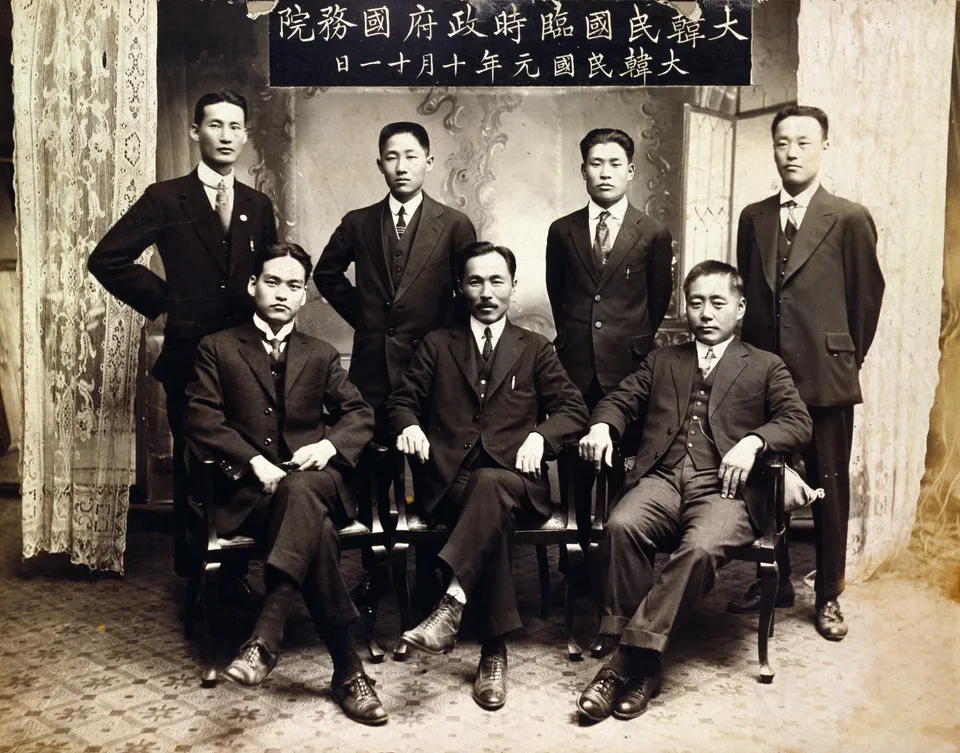
Commemorative photo of the founding of the Provisional Government — Shanghai, October 1919

Unknown author · Public domain · Source

After the March First Movement the Korean National Council in the Maritime Province, the Hanseong government in Seoul and a government in Shanghai were formed in quick succession. On 11 April 1919 the Provisional Assembly in Shanghai adopted the name "Republic of Korea" and a Provisional Charter establishing a democratic republic; on 11 September the three governments merged under President Syngman Rhee and Premier Yi Dong-hwi, with separate legislative, executive and judicial branches.

For secret links with Korea it built the yeontongje (an underground administration down to township level) and the gyotongguk (a communications network run through the Irish-owned Ilung Company in Dandong), sold independence bonds and raised funds through the Ilung Company and the Baeksan Trading Company. It kept diplomatic missions in Paris (Kim Kyu-sik) and Washington, published the Dongnip sinmun, compiled historical materials on Korea–Japan relations and placed the Western and Northern military administrations under its war ministry.

By around 1921 the yeontongje and gyotongguk had been exposed and broken and diplomacy had achieved little, and the government stagnated. Rhee’s petition for a League of Nations mandate and disputes over strategy led to the National Representatives’ Conference of 1923.

The map in 1919

OpenFreeMap © OpenMapTiles © OpenStreetMap contributors

States at the time
Republic of China
Places
Provisional Government Building, Shanghai

People

  • Syngman Rhee1875 – 1965

    participant · First President of the Provisional Government, who worked through diplomacy in the US; later first President of the Republic of Korea

  • Ahn Chang-ho1878 – 1938

    leader · Founder of the Sinminhoe and the Heungsadan; as Interior Minister of the Provisional Government he set up the yeontongje network

  • Yi Dong-hwi1873 – 1935

    participant · Vice-president of the Korean Gwangbokgun Government and first Premier of the Provisional Government; founded the Korean Socialist Party

  • Kim Gu1876 – 1949

    participant · Known as Baekbeom; founded the Korean Patriotic Organization and led the Liberation Army as Chairman of the Provisional Government

  • Yeo Un-hyeong1886 – 1947

    participant · Founded the New Korea Youth Party in Shanghai and in 1944 the underground Korean Founding League at home

  • Kim Kyu-sik1881 – 1950

    diplomat · Envoy of the New Korea Youth Party to the Paris Peace Conference, later Vice-Chairman of the Provisional Government

  • Yi Dong-nyeong1869 – 1940

    participant · Sinminhoe member who helped found the Sinheung school in western Jiandao and served as Speaker of the Provisional Assembly and head of the Provisional Government

  • Yi Si-yeong1869 – 1953

    participant · Younger brother of Yi Hoe-yeong who went into exile with his brothers, helped found the Sinheung school, served the Provisional Government as Minister of Justice and Finance and became the first Vice President of the Republic of Korea

  • Sin Gyu-sik1880 – 1922

    participant · Founded the Dongjesa in Shanghai and led the 1917 Declaration of Great Unity; served the Provisional Government as Justice Minister and acting Premier

Before and after

Themes that include this event

  • Republican China and Imperial Japan1912 – 1949

    The age when the Republic of China, born of the 1911 Revolution, passed through warlord division, the May Fourth Movement, the United Front and the Northern Expedition, fought Japan’s invasion and split in civil war — as Japan moved from Taishō democracy through the Manchurian Incident and military coups to the war in China and the Co-Prosperity Sphere, and colonized Korea resisted through the March First Movement and armed struggle