May Fourth Movement
Also called: 4 May Movement
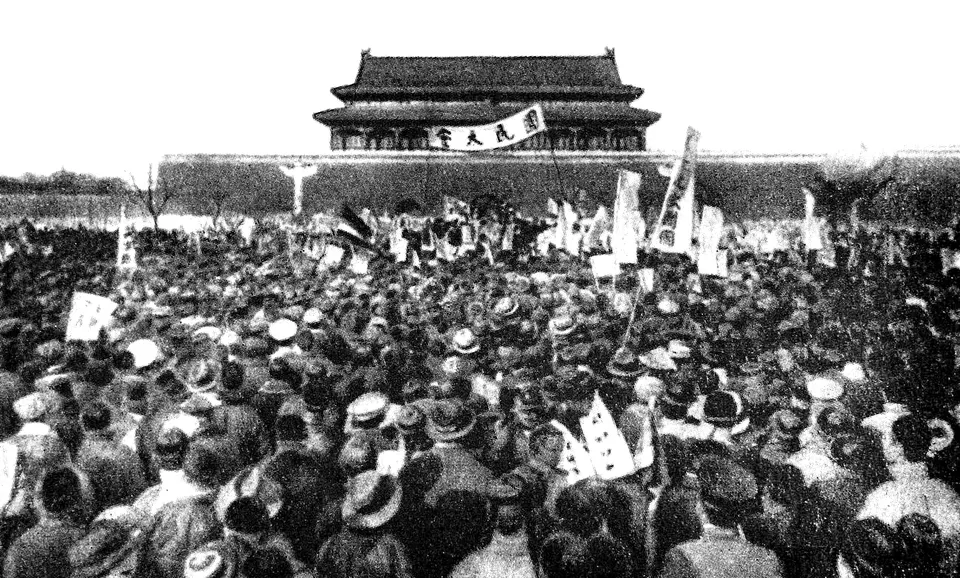
When the Paris Peace Conference decided to hand Germany’s former rights in Shandong to Japan, Beijing students demonstrated in front of Tiananmen on 4 May 1919, and an anti-imperialist, anti-warlord movement spread nationwide.
Unknown author · Public domain · Source
China had joined the First World War on the Allied side hoping to recover Shandong, but in April 1919 the Paris Peace Conference accepted Japan’s claims. On 4 May some 3,000 Beijing students gathered before Tiananmen calling to “defend sovereignty abroad and punish the traitors at home”, and set fire to the house of the pro-Japanese official Cao Rulin. News of Korea’s March First Movement that spring had also stirred Chinese intellectuals.
When the government arrested students, merchants in Shanghai shut their shops and workers struck in June, carrying the movement across the country. The government finally dismissed three pro-Japanese officials, and on 28 June the Chinese delegation refused to sign the Treaty of Versailles.
Joining students, workers and merchants, the May Fourth Movement was a mass anti-imperialist movement and is counted as the beginning of modern Chinese history. It carried the ideas of the New Culture Movement to a wider public; that year Sun Yat-sen reorganized his party as the Chinese Nationalist Party (Kuomintang), and intellectuals who had embraced Marxism founded the Chinese Communist Party two years later.