Science24 January 1986

Voyager 2 at Uranus

On 24 January 1986 Voyager 2 became the first — and so far the only — spacecraft to pass Uranus. It found ten new moons and two new rings.

Uranus from Voyager 2, January 1986

NASA/JPL-Caltech · Public domain · Source

Uranus is tipped over by 98° and rolls round the Sun on its side; when Voyager 2 arrived its south pole faced the Sun. Passing 81,000 km above the cloud tops on 24 January, the probe found ten new moons and two new rings, and a magnetic field tilted far from the spin axis. The moon Miranda showed a jumbled surface, as if pieced together from fragments.

Four days later, on 28 January, the space shuttle Challenger broke apart just after launch, killing seven. The news from Uranus was lost in the grief.
The map in 1986

OpenFreeMap © OpenMapTiles © OpenStreetMap contributors

States and rulers at the time
United States — President Ronald Reagan
Places
Jet Propulsion Laboratory

People

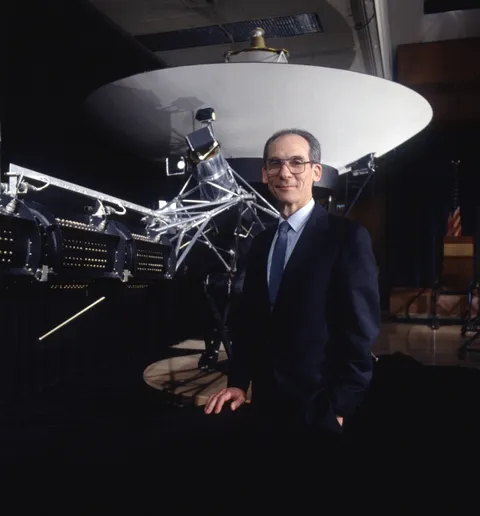
  • Edward Stone1936 – 2024

    key figure · American physicist, project scientist of the Voyager mission for fifty years (1972–2022) and director of the Jet Propulsion Laboratory (1991–2001)

Before and after

Earlier
1980 Voyagers at Saturn

Themes that include this event

  • Space Exploration1957 – 2012

    From Sputnik, the first artificial satellite, to Apollo 11’s first landing on the Moon, Apollo 13’s return from behind it and the Voyagers, which passed the outer planets and went on into interstellar space — the paths of the people and probes that left the Earth