Voyages of Zheng He
Also called: Treasure voyages, Ming treasure voyages
At the Yongle Emperor’s command the eunuch Zheng He led seven great fleets between 1405 and 1433 through Southeast Asia to India, the Persian Gulf, Arabia and East Africa, displaying Ming power and enlisting new tributary states.
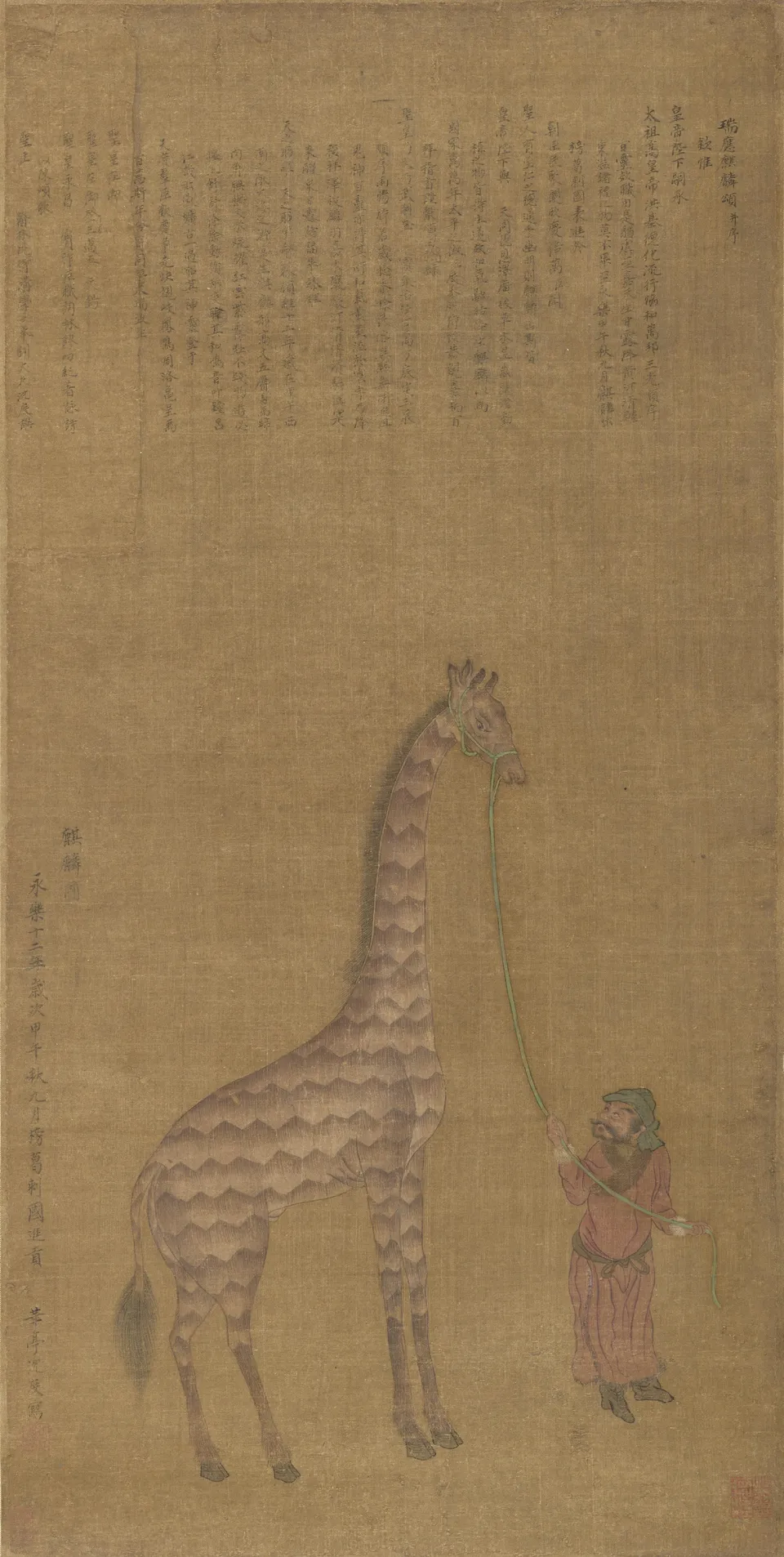
Shen Du (沈度, 1357–1434) Note: In contrast to the other references, the Philadelphia Museum of Art considers this to be rather a later work by an unknown painter from the 16th century. · Public domain · Source
Yongle entrusted the fleet to Zheng He, a eunuch from a Muslim family, to display Ming might abroad and draw other states into the tribute system (some say also to hunt for the vanished Jianwen Emperor). According to the History of Ming the first voyage of 1405 carried more than 27,000 men in 62 large ships, and the biggest treasure ships are said to have been well over 100 metres long, though scholars disagree on their size.
The fleets sailed by way of Champa, Java and Malacca to Calicut on India’s southwest coast, and later voyages reached Hormuz in the Persian Gulf, Aden in Arabia and Malindi and Mogadishu in East Africa. Malacca served as a forward base; envoys from many lands came to pay tribute, and a giraffe sent from Malindi caused a sensation. The seventh voyage, of 1431–1433, came under the Xuande Emperor, and Zheng He is said to have died during it.
These voyages came more than ninety years before Vasco da Gama, but their huge cost, the needs of northern defence and the sea ban meant they were never resumed. Even so, they helped Chinese communities take root in Southeast Asia, and Malacca grew into an international port under Ming protection.